What’s inside
Every client call this quarter includes some version of “will we be shut out of AI Mode?” It’s a fair worry. When product discovery moves into an AI conversation, the brands that appear are the ones whose data the system understands and whose policies it trusts. For regulated categories, that raises the stakes on work most brands haven’t done. This guide separates what’s actually been announced from speculation, and gives a practical checklist.
What Google has announced so far
| Date | What happened |
|---|---|
| 11 January 2026 | “Direct Offers” pilot in AI Mode with retailers including Petco, e.l.f. Cosmetics, Samsonite, Rugs USA and Shopify merchants |
| 11 February 2026 | Google announces sponsored Shopping ads in AI Mode, labelled as sponsored and shown at “key moments of discovery” in AI conversations; Google cites over 75 million daily active users of AI Mode |
| 2026 | Checkout integrations in AI Mode for US merchants via Google’s commerce protocol, as part of its agentic commerce push |
| September 2026 | Shopping ads and free listings policies merged into one Shopping policy set, with Google stating no substantive or more restrictive changes |
Google’s published research on AI Mode shopping (4,773 participants, October–December 2025) emphasised users comparing “a variety of brands and stores.” That’s encouraging for smaller brands, if their data qualifies.
What hasn’t been published
As of this update, coverage of the launch does not specify:
- Exact campaign-type eligibility (how Shopping and Performance Max inventory maps to AI Mode placements).
- Any additional restrictions for health, supplement or other sensitive categories.
- Market-by-market availability beyond “markets where the feature has deployed.”
If an agency tells you exactly how AI Mode treats supplements or peptides, ask for the Google source. Much of what’s circulating is inference. We’ll update this guide as Google publishes more.
How Google’s policies apply in AI Mode
An ad format doesn’t create a new policy regime. Shopping ads in AI Mode draw on your Merchant Center products, which are governed by the same rules wherever they serve. For regulated brands, that means:
| Category | Status under Shopping policies | AI Mode implication |
|---|---|---|
| Supplements with compliant claims | Generally allowed, with restrictions on claims and certain ingredients | Eligible in principle; data quality and claims decide visibility |
| Supplements with disease or prescription-level claims | Disapproved (unapproved claims) | Not eligible |
| Research peptides / unapproved substances | Prohibited regardless of claims of legality | Not eligible; AI Mode doesn’t change that |
| Prescription drugs | Certified online pharmacies, US/Canada only | Subject to certification and any additional limits |
| CBD | Highly restricted by product type and location | Narrow, certification-dependent |
Health topics are also where Google’s systems are most conservative in what they surface organically, so it’s reasonable to expect AI Mode to favour products with unambiguous, well-documented data and trustworthy sites. See selling supplements on Google Shopping and Google Ads policy for peptides.
Building an AI-ready feed for regulated products
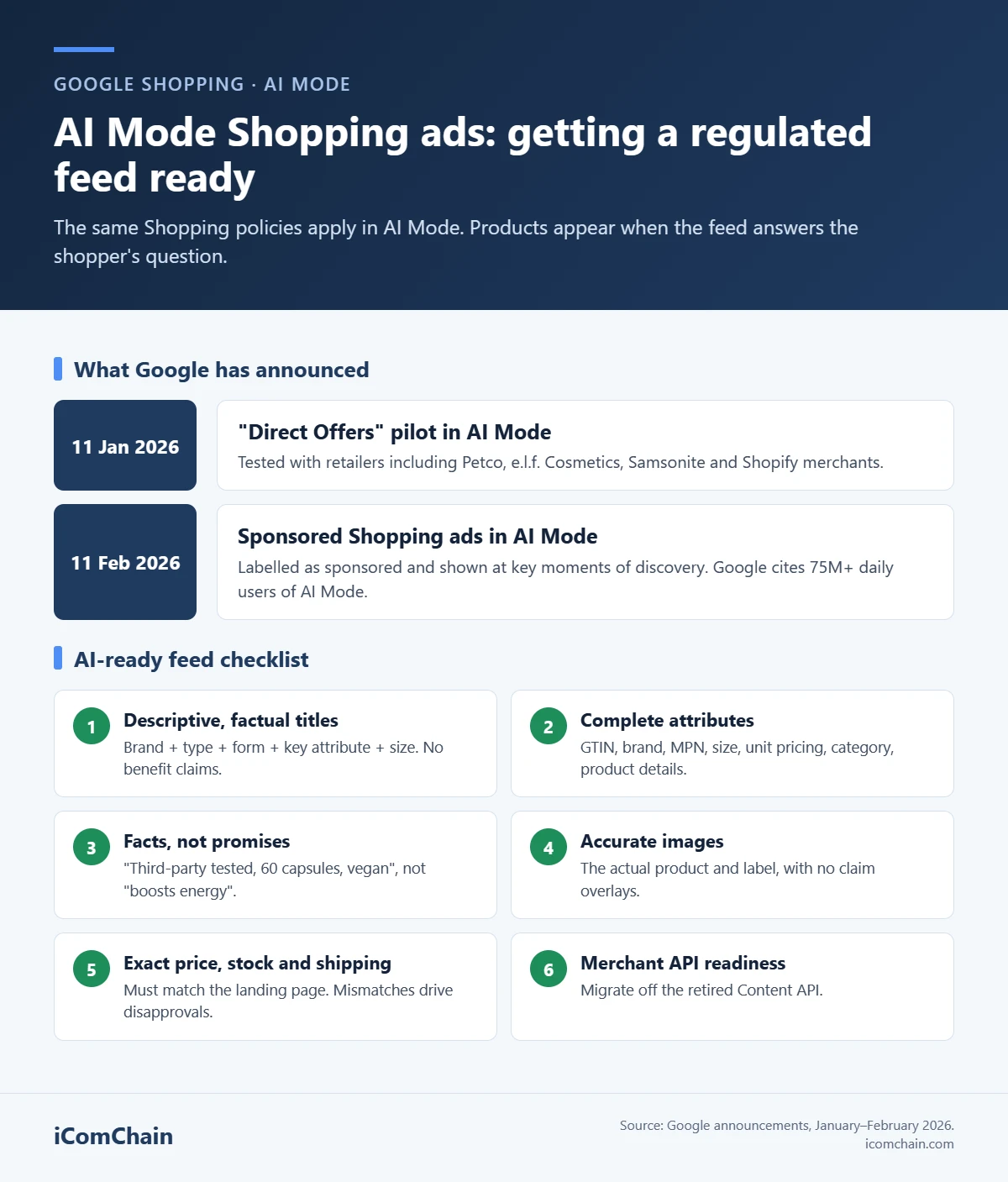
AI systems answer comparative questions: “magnesium glycinate without fillers,” “third-party tested creatine under $40,” “vegan protein for runners.” Products appear when the feed contains the attributes needed to match those questions. For regulated categories that has to be done without crossing into claims.
- Descriptive, factual titles. Brand + product type + form + key attribute + size. No benefit claims in titles. See our Shopping structure guide.
- Complete attributes. GTIN, brand, MPN where applicable, size, unit pricing measure, product type, Google product category, and relevant product details (ingredients, form, serving count).
- Product highlights and details that are facts, not promises. “Third-party tested, lot #, 60 capsules, vegan” rather than “boosts energy.”
- Accurate images showing the actual product and label, no claim overlays.
- Price, availability and shipping that match the landing page exactly. Mismatches are a leading cause of disapprovals; see disapproved products: every fix.
- Merchant API readiness. If you still rely on the retired Content API, migrate. See our Merchant API migration guide.
The website side: answer-ready pages
AI Mode and other answer engines draw on your website, not just your feed. The same work that improves organic AI citations improves your chances in AI-driven shopping:
- Clear product facts near the top of each page: what it is, form, size, testing, who it’s for, in neutral language.
- Structured data (Product, Offer, MerchantReturnPolicy, shipping details) matching the feed.
- Trust signals: real business identity, policies, lot-level certificates of analysis, and reviews that don’t make health claims.
- FAQ content answering real comparison questions factually.
- Agentic readiness: machine-readable policies and checkout. See our agentic commerce readiness guide.
Rewriting titles and highlights to be fact-led, filling every optional attribute that applies, adding return-policy and shipping structured data, and aligning product pages with the feed word for word on the key facts. It improves today’s Shopping and Performance Max results as well as AI Mode readiness.
15 questions answered
What are Shopping ads in AI Mode?
Sponsored product listings that appear inside Google’s AI Mode conversations, labelled as sponsored. Google announced them on 11 February 2026.
Do I need a new campaign type for AI Mode?
Google hasn’t published a separate AI Mode campaign type in the coverage we reviewed. Shopping ads draw on Merchant Center products; check your Google Ads account and Google’s announcements for current eligibility.
Can supplement brands appear in AI Mode shopping ads?
In principle, if their products comply with Shopping policies. Compliant claims, complete product data and a trustworthy site are the deciding factors.
Can research peptides appear in AI Mode?
No. Unapproved substances are prohibited under Google’s Shopping policies regardless of format or claims of legality.
Are there extra rules for health products in AI Mode?
Google hasn’t published category-specific AI Mode rules that we’ve seen. Expect existing healthcare policies to apply and Google’s systems to be conservative on health topics.
Did the September 2026 policy merge change anything for AI Mode?
Google stated the consolidation of Shopping ads and free listings policies introduced no substantive or more restrictive changes. It does mean one policy set governs all Shopping surfaces.
What feed attributes matter most for AI Mode?
Accurate titles, GTIN and brand, product type and category, size and unit pricing, product details and highlights, images, price, availability and shipping. Completeness helps AI systems match products to specific questions.
Should I put benefits in product highlights?
For regulated categories, no. Use verifiable facts such as testing, form, ingredients and size. Benefit claims risk disapproval.
Does structured data on my site matter?
Yes. Product, Offer, return policy and shipping structured data that match your feed help Google verify and understand your products.
Is AI Mode available outside the US?
Google says AI Mode is available in markets where it has deployed, and checkout integrations were described for the US. Check Google’s current availability for your markets.
Will AI Mode replace Performance Max?
There’s no indication of that. AI Mode is a new placement; Performance Max and Shopping campaigns remain the main way to buy Shopping inventory.
How do I know if my products show in AI Mode?
Reporting granularity for AI Mode placements may be limited. Watch Google Ads reporting updates and segment by placement where available.
Does organic AI visibility affect AI Mode ads?
They’re separate systems, but both reward clear, trustworthy product information. Work on one usually helps the other.
What’s the first thing to fix?
Policy compliance and feed accuracy. A disapproved or suspended product can’t appear anywhere, including AI Mode.
Can iComChain make our feed AI-ready?
Yes. Our Google Shopping management includes fact-led feed engineering, structured data alignment and policy review for regulated categories.
Is your feed ready for AI Mode?
Book a 15-minute call. We’ll review your feed and product pages and show you what an AI-ready, policy-safe version looks like.
Sources
- PPC Land: Google unveils shopping ads in AI Mode
- PPC Land: Google merges two Shopping policy sets
- eMarketer: Google brings checkout to AI Mode
- Google: Digital advertising and commerce in 2026
- Google Merchant Center Help: Shopping policies
General information only. iComChain is not affiliated with Google. AI Mode features and availability change frequently; facts reflect public sources available on 22 October 2026.