What’s inside
Most merchants who reach us after a third or fourth suspension have the same history: a generic suspension notice, a quick fix to the obvious issue, an appeal, approval, and a new suspension weeks later for something that was there all along. Each cycle chips away at Google’s trust in the account. By the time you’re here, the question isn’t only “is the store compliant now?” but “why should Google believe it will stay compliant?” This guide is about answering both.
Why repeat suspensions are different
- The review is more sceptical. Reviewers see your history. A short “we fixed it” appeal that worked the first time won’t now.
- Waiting periods can lengthen after rejected appeals, and some findings carry no right to relist.
- Linked accounts are at risk. Repeated violations can escalate to action across accounts tied to the same business. See repeated violations and entity-level bans.
- Google’s AI review reads everything. Since 2026, much initial review is automated and reads the whole site, so leftover issues surface faster. See passing the AI Merchant Center review.
Step zero: stop making it worse
- Submit another appeal “to see what happens.”
- Open a new Merchant Center or Google Ads account, or let a contractor use theirs.
- Move to a new domain with the same products.
- Rename or hide prohibited products.
All of these either burn credibility or count as circumventing systems. If any have already happened, write them down. You’ll need to address them honestly.
Finding the root cause across every suspension
List every suspension, disapproval wave and warning the account has received, with dates and the policy named. Then look for the pattern. In our casework the root cause is usually one of these:
| Pattern in the history | Likely root cause |
|---|---|
| Misrepresentation, then website needs improvement, then misrepresentation again | Business identity and policies were patched, but claims, reviews or content elsewhere on the site still contradicted the feed |
| Unapproved substances recurring after removals | Prohibited products, or their content, remained somewhere (blog, bundles, variants, old URLs, email archives) |
| Untrustworthy promotions after misrepresentation | Discounts, “was” prices or urgency tactics that weren’t fixed with the rest |
| Suspension weeks after each approval | Fixes were made to the feed or a few pages only; Google’s full-site review found the rest |
| Circumventing systems | A new account, domain or renamed products, often from a previous “fix” |
Our diagnostic hub and $149 audit tool help map symptoms to causes.
Building the evidence pack
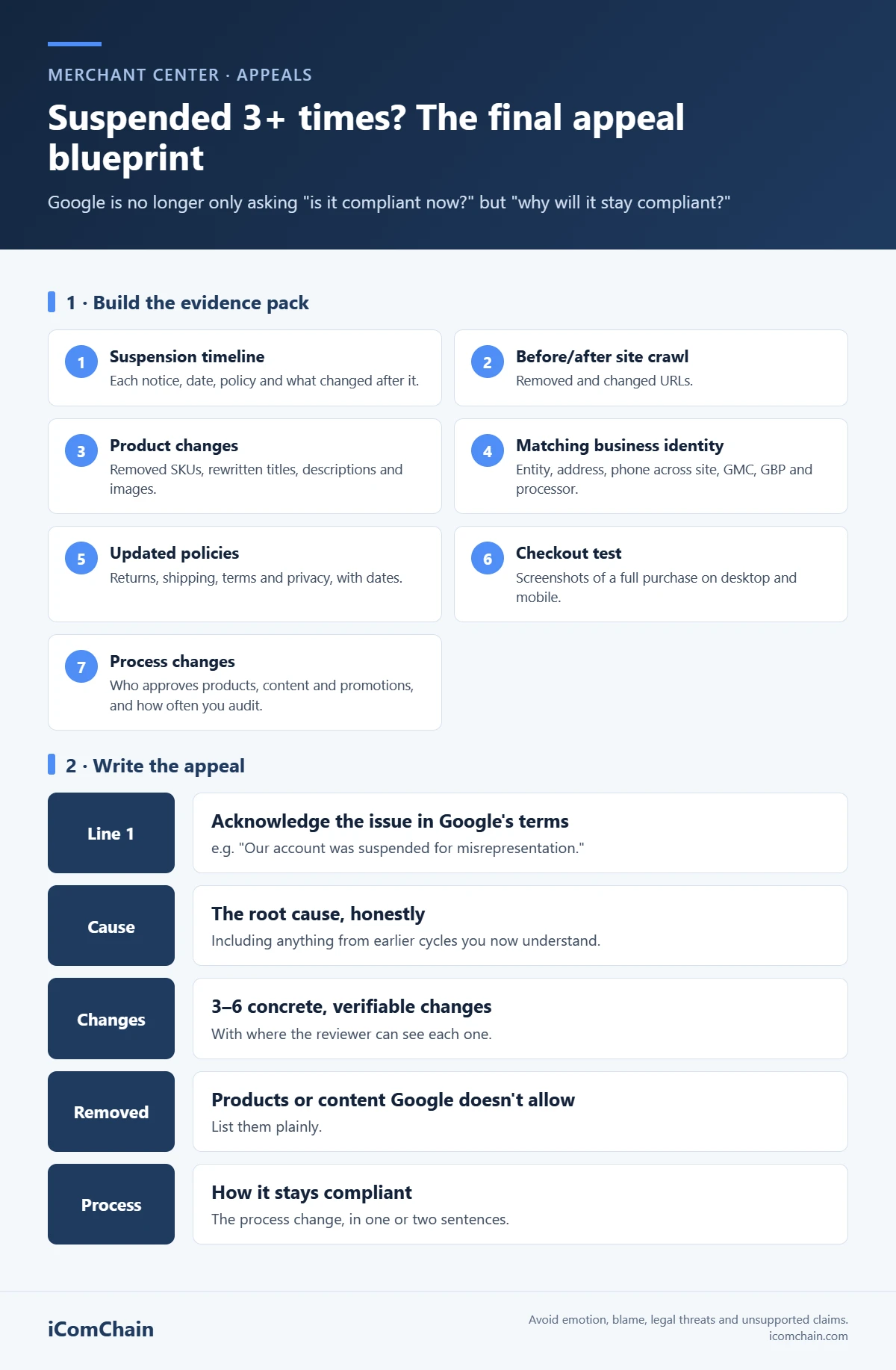
Before you write a word of appeal, assemble a private dossier. You won’t send all of it, but it disciplines the work and gives you specifics to cite.
- Suspension timeline: each notice, date, policy and what you changed after it.
- Full-site crawl, before and after, showing removed and changed URLs.
- Product changes: removed SKUs, rewritten titles and descriptions, image changes.
- Business identity: legal entity, registration, address, phone, matching across site, Merchant Center, Google Business Profile and payment processor.
- Policies: returns, shipping, terms, privacy, with dates updated. See pages you need to pass review.
- Checkout test: screenshots of a complete purchase on desktop and mobile.
- Process changes: who now approves new products, content and promotions, and how often you audit. This is what answers “why will it stay fixed?”
Writing the appeal
Keep it short, specific and factual. Reviewers handle many cases; clarity helps.
- One sentence acknowledging the issue in Google’s terms (e.g. “Our account was suspended for misrepresentation”).
- The root cause, honestly: what was wrong, including anything from earlier cycles you now understand.
- What changed: three to six concrete, verifiable changes, with where to see them.
- What you removed: any products or content Google doesn’t allow.
- How you’ll keep it compliant: the process change, in one or two sentences.
- If applicable: acknowledgement that a previous new account or domain was a mistake and has been closed.
Avoid emotion, blame, legal threats, long histories of your business, and claims you can’t support. Never claim a product is legal in an attempt to override Google’s policy; Google applies healthcare rules “regardless of any claims of legality.”
What recovery looked like for one brand
One UK peptide brand we worked with came to us selling through direct messages and payment links after a Merchant Center suspension had shut down its Shopping channel. The recovery followed the sequence above: root cause across the history, a store and feed rebuilt to policy standard, consistent business identity, one evidence-backed appeal, then compliant Google Ads and retention email layered on afterwards. As described on our peptide marketing page, it went on to exceed £1M in monthly revenue within about 14 months. Results vary and aren’t guaranteed, but the order of operations is the part that transfers.
When to stop
Sometimes the honest answer is that the account isn’t recoverable, or the products can’t run on Google at all. Signs include:
- A finding of unauthorised pharmacy or another egregious violation with no right to relist.
- A core catalogue made of products Google prohibits, such as investigational GLP-1s. See GLP-1 listings and Merchant Center.
- An entity-level ban covering the business.
In those cases, money is better spent on channels you control. See where to advertise peptides and peptide SEO.
15 questions answered
How many appeals does Google allow for Merchant Center?
Google doesn’t publish a fixed number. Repeated rejected appeals reduce credibility and can extend waiting periods, and egregious violations may not be appealable at all.
Why does my account keep getting suspended after approval?
Usually because fixes covered the feed or a few pages while other issues remained on the site. Google’s full-site review finds them weeks later. Fix the root cause across the whole domain.
Should I wait before appealing again?
Yes. Wait until every change is live and documented. A delayed, strong appeal beats a quick, weak one.
What should the appeal say?
Acknowledge the issue, explain the root cause honestly, list specific changes and removals, and explain how you’ll keep the account compliant. Keep it concise and factual.
Should I mention earlier mistakes like a second account?
Yes, briefly and honestly, and confirm it has been closed. Reviewers can usually see linked activity; candour builds credibility.
Can I attach documents to an appeal?
The appeal form typically lets you explain changes; some flows allow additional information or verification documents. Keep your evidence pack ready in case Google requests it.
Is an entity-level ban permanent?
It can be. Google may refuse to work with a business across accounts after repeated or egregious violations. See our entity ban guide.
Can a new business owner or entity start fresh?
A genuinely new, unrelated business can open an account. Restructuring the same business to get around a ban is circumventing systems.
How long does review take after a final appeal?
It varies from days to several weeks. Avoid making major site changes while the review is pending unless they further improve compliance.
Does Google Ads get suspended too?
It can, through linked business and payment data, particularly for circumvention or egregious healthcare violations.
Should I remove products Google might not allow?
Yes. Keeping borderline or prohibited products on the site during review is one of the main reasons repeat appeals fail.
Do I need a specialist for a third appeal?
Not necessarily, but an outside audit catches what you’ve become blind to. Choose someone who won’t suggest new accounts or domains.
What if the appeal is denied again?
Reassess whether the products and business model can run on Google. Read what to do after an appeal is denied and consider other channels.
Can my peptide store ever be reinstated?
Some can, depending on products and positioning; many peptides are unadvertisable on Google regardless. An honest assessment upfront saves money.
What does iComChain charge for a repeat case?
Our Merchant Center reinstatement is a flat $1,500. For repeat cases we assess recoverability on the first call before taking payment.
On your third or fourth suspension?
Book a 15-minute call. We’ll review the account history and tell you honestly whether it’s recoverable, and what the appeal needs to show.
Sources
- Google Merchant Center Help: Misrepresentation
- Google Merchant Center Help: Healthcare and medicines (enforcement and appeals)
- Google Ads Policy Help: Circumventing systems
- Google Merchant Center Help: Shopping policies
General information only. iComChain is not affiliated with Google and cannot guarantee reinstatement. Client results are from selected engagements and are not a guarantee of future performance. Facts reflect public sources available on 22 October 2026.