What’s inside
GLP-1 products are the highest-revenue SKUs in the online peptide market and the fastest way to lose a Merchant Center account. We regularly speak with store owners whose entire catalogue was approved for months, then suspended within days of adding a “research grade” semaglutide or retatrutide listing. This guide explains exactly which policies are triggered and what, if anything, can be done about it. If you want a broader view of GLP-1 marketing across channels, read our GLP-1 advertising compliance guide.
Why GLP-1 listings are treated differently
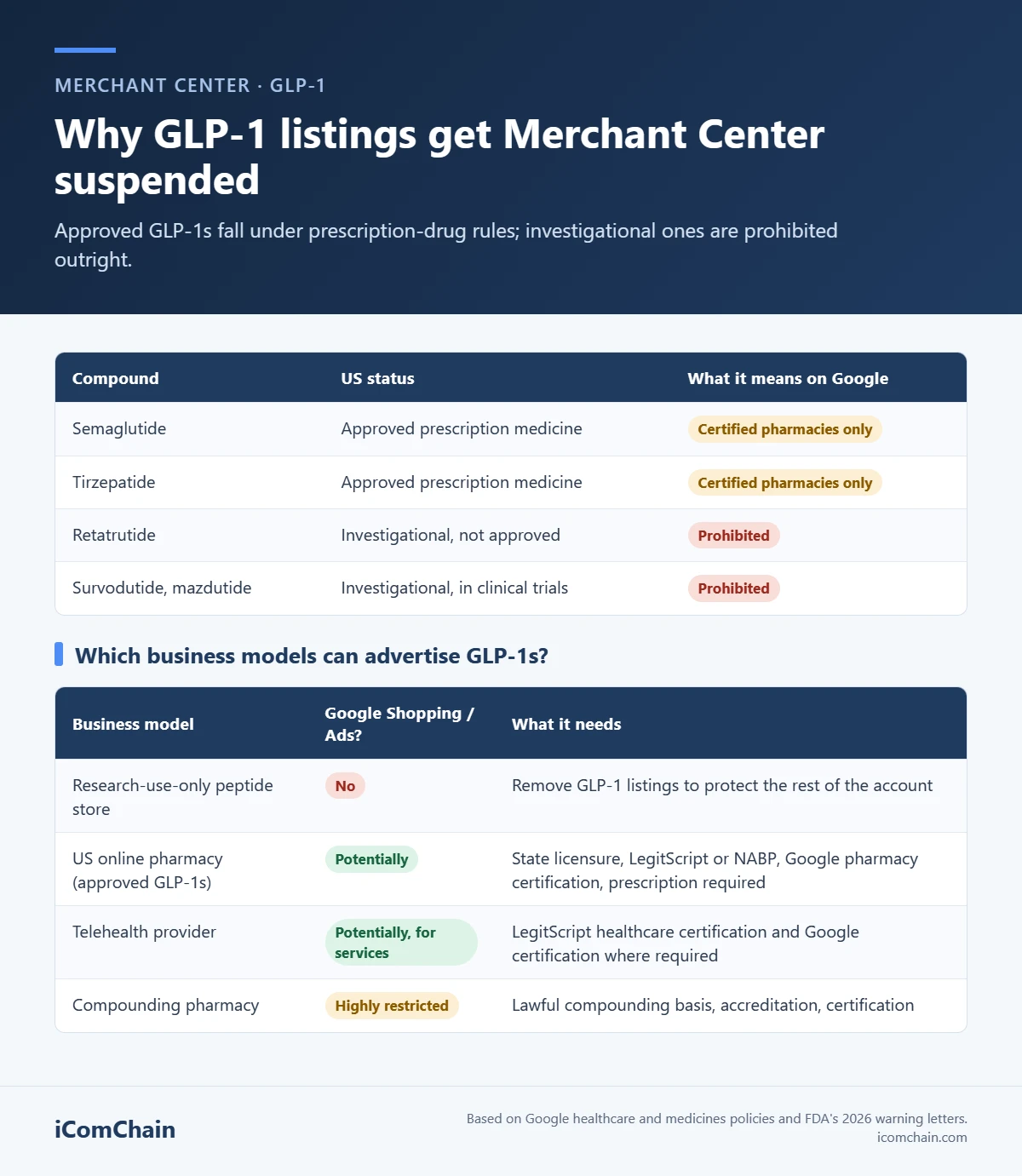
| Compound | Regulatory status (US) | What that means on Google |
|---|---|---|
| Semaglutide | Approved prescription medicine (e.g. Ozempic, Wegovy) | Prescription-drug rules: certified pharmacies only |
| Tirzepatide | Approved prescription medicine (e.g. Mounjaro, Zepbound) | Prescription-drug rules: certified pharmacies only |
| Retatrutide | Investigational, not approved | Unapproved substance: prohibited |
| Survodutide, mazdutide | Investigational, in clinical trials | Unapproved substance: prohibited |
Two things make GLP-1s especially sensitive. First, the approved versions are among the most searched prescription medicines in the world, so Google’s systems are tuned to catch unauthorised sales of them. Second, the shortages that once allowed wide-scale compounding of semaglutide and tirzepatide have been declared resolved by FDA, which narrowed the legal space for copies further.
The three Google rules a GLP-1 listing runs into
1. Prescription drugs
Merchant Center allows prescription drugs only in the United States and, in some cases, Canada, and only from online pharmacies accredited by LegitScript, NABP (Digital Pharmacy/VIPPS) or Pharmacy Verified Websites and certified by Google. Offering prescription drugs without requiring a prescription is classed as an unauthorised pharmacy, an egregious violation that can lead to suspension without warning and no right to relist.
2. Unapproved substances
Google prohibits unapproved pharmaceuticals and supplements, “close chemical equivalents,” products claiming prescription-level effects, products under regulatory action, and products with names confusingly similar to approved drugs. “Retatrutide research peptide” and “Sema 5mg (research)” sit squarely in these categories. The “research use only” label is irrelevant to Google, which applies these rules “regardless of any claims of legality.”
3. Misrepresentation
Many GLP-1 stores present themselves as laboratory suppliers in the feed and as weight-loss sellers on the site, in reviews or in email. Google reviews the whole site. That gap is a textbook misrepresentation finding.
Unauthorised pharmacy and unapproved-substance findings are treated at account level. One GLP-1 listing can suspend a store whose other products are entirely compliant, and the suspension often extends to Google Ads accounts linked to the same business.
What FDA’s 2026 letters added
FDA’s warning letters dated 24 August 2026 to online peptide sellers named semaglutide, tirzepatide and retatrutide in every case, plus survodutide and mazdutide in some. FDA cited weight-loss, appetite and metabolism claims, dosing guides and calculators, and bacteriostatic water sold for reconstitution, and treated “research use only” disclaimers as no defence. Google’s policies already prohibit products “subject to regulatory action or warning,” so a public FDA focus on GLP-1 sellers increases the likelihood and speed of enforcement. See our FDA warning letter guide and website audit.
The routes that can work
| Business model | Can it use Google Shopping / Ads for GLP-1s? | What it needs |
|---|---|---|
| Research-use-only peptide store | No | Remove GLP-1 listings to protect the rest of the account |
| US online pharmacy dispensing approved GLP-1s | Potentially | State licensure, LegitScript or NABP accreditation, Google online pharmacy certification, prescription required |
| Telehealth provider prescribing approved GLP-1s | Potentially, for services | LegitScript healthcare certification and Google certification where required; follow prescription-drug ad rules |
| Compounding pharmacy | Highly restricted | Lawful compounding basis, accreditation, certification; advertising compounded GLP-1s faces heavy scrutiny |
If you’re a research supplier and GLP-1s are a large share of revenue, the honest conversation is about the business model, not the listing. Many of our peptide clients grow faster on Google after removing GLP-1s because the rest of the catalogue can finally run without constant suspension risk.
- Remove all GLP-1 and other investigational-drug listings from the feed and site.
- Remove GLP-1 content from the blog, FAQ, reviews and email archives linked from the site.
- Remove comparisons to branded medicines anywhere on the domain.
- Audit the rest of the catalogue: see Merchant Center for research peptides.
Already suspended? What to do
- Remove every GLP-1 and investigational listing from the feed and site. Don’t rename them.
- Clean the rest of the domain, including blog posts, reviews and bundles.
- Check Google Ads for keywords and ads referencing GLP-1s and remove them.
- Do not open a new account or domain. That’s circumventing systems.
- Appeal once, after the changes are live, explaining what was removed. Unauthorised-pharmacy findings may not be appealable; an honest specialist will tell you.
15 questions answered
Can I sell semaglutide on Google Shopping?
Only as a US (or, in limited cases, Canadian) online pharmacy that is accredited by LegitScript, NABP or Pharmacy Verified Websites, certified by Google, and requires a prescription. Research-use-only semaglutide listings are prohibited.
Is retatrutide allowed on Merchant Center?
No. Retatrutide is investigational and not approved, so Google treats it as an unapproved substance, prohibited regardless of claims of legality.
Why was my whole account suspended for one GLP-1 product?
Unauthorised pharmacy and unapproved substance violations are enforced at account level, and some are classed as egregious, allowing suspension without warning.
Does a “research use only” label make GLP-1 listings acceptable?
No. Google applies its unapproved substances policy regardless of claims of legality, and FDA’s 2026 letters showed it does not treat the disclaimer as a defence either.
Can I list GLP-1s under abbreviations like “Sema” or “Tirz”?
No. Google prohibits names confusingly similar to approved drugs, and renaming to avoid detection is circumventing systems.
Were GLP-1 products named in FDA’s 2026 warning letters?
Yes. Semaglutide, tirzepatide and retatrutide appeared across the letters dated 24 August 2026, with survodutide and mazdutide in some.
Can telehealth companies advertise GLP-1 treatment on Google?
Potentially, with appropriate LegitScript and Google certifications and compliance with prescription-drug advertising rules. Requirements vary by country and change over time.
Can compounding pharmacies advertise compounded semaglutide?
It is highly restricted. FDA has declared the semaglutide and tirzepatide shortages resolved, narrowing the basis for compounding, and Google requires accreditation and certification.
Will removing GLP-1 listings get my account reinstated?
It’s necessary but not always sufficient. The rest of the site, feed and business information must also comply, and some egregious findings can’t be appealed.
Can I keep GLP-1 blog content if I remove the products?
Content that discusses weight-loss use or dosing on a store’s domain still signals intended use to Google and regulators. Remove or substantially rewrite it.
What about GLP-1 supplements and “natural Ozempic” products?
Google prohibits products claiming prescription-level effects and confusingly similar names. “Natural Ozempic” style marketing is a common cause of disapproval.
Can I advertise GLP-1 products on Meta instead?
Meta’s policies on prescription drugs and weight-loss products are also strict. See Meta ads for peptides.
Do Google Ads have the same rules as Merchant Center?
Broadly yes. Google Ads Healthcare and medicines policies also prohibit unapproved substances and restrict prescription drugs to certified advertisers.
How long does a GLP-1-related suspension last?
Until the violation is fixed and an appeal succeeds, if it is appealable. Unauthorised-pharmacy findings can be permanent.
Can iComChain get my GLP-1 products approved?
Not as a research-use-only store; nobody legitimately can. We help remove the risk, recover the rest of the account, and for accredited pharmacies and telehealth providers, set up compliant campaigns.
GLP-1 listings putting your account at risk?
Book a 15-minute call. We’ll tell you what Google sees, what has to go, and what can keep running.
Sources
- Google Merchant Center Help: Healthcare and medicines
- Google Ads Policy Help: Healthcare and medicines
- Sheppard Mullin: analysis of the August 2026 peptide warning letters
- Analysis of FDA’s September 2026 warning-letter sweep
- FDA: Concerns with unapproved GLP-1 drugs used for weight loss
General information only, not legal, regulatory or medical advice. Brand names are trademarks of their owners and are used for identification only. Research-use-only (RUO) products are intended for laboratory research only and not for human consumption. Facts reflect public sources available on 22 October 2026.