What’s inside
Search freelance marketplaces for “Merchant Center reinstatement” or “fix GMC suspension” and you’ll find hundreds of listings, many specifically for peptide, GLP-1 and supplement stores, starting around $20–$50. Some are offered by people who know the policies well. Many are not. This article is not about naming anyone. It’s about the tactics that come up again and again when merchants arrive at our door after a cheap fix went wrong, and why Google treats those tactics so harshly.
We have not run a sting on freelancers. What follows is drawn from Google’s published policies and from the account histories merchants share with us when they come to us after a failed fix. Where we describe a pattern, it’s one we’ve seen repeatedly, not a single anecdote.
Why the cheap-fix market exists
A suspended Merchant Center account switches off Shopping ads and free listings overnight, and for many e-commerce brands that’s a large share of revenue. Google’s suspension notices are short and generic. Founders want the problem gone today, and a $50 promise to “get you approved in 24–48 hours” is tempting.
The trouble is that Merchant Center suspensions are almost never caused by a setting. They’re caused by what’s on the website, in the feed and in the business information, and by how those three agree with each other. A fix that doesn’t touch those can only work by getting around Google’s review rather than passing it.
The four shortcuts, and what Google does about each
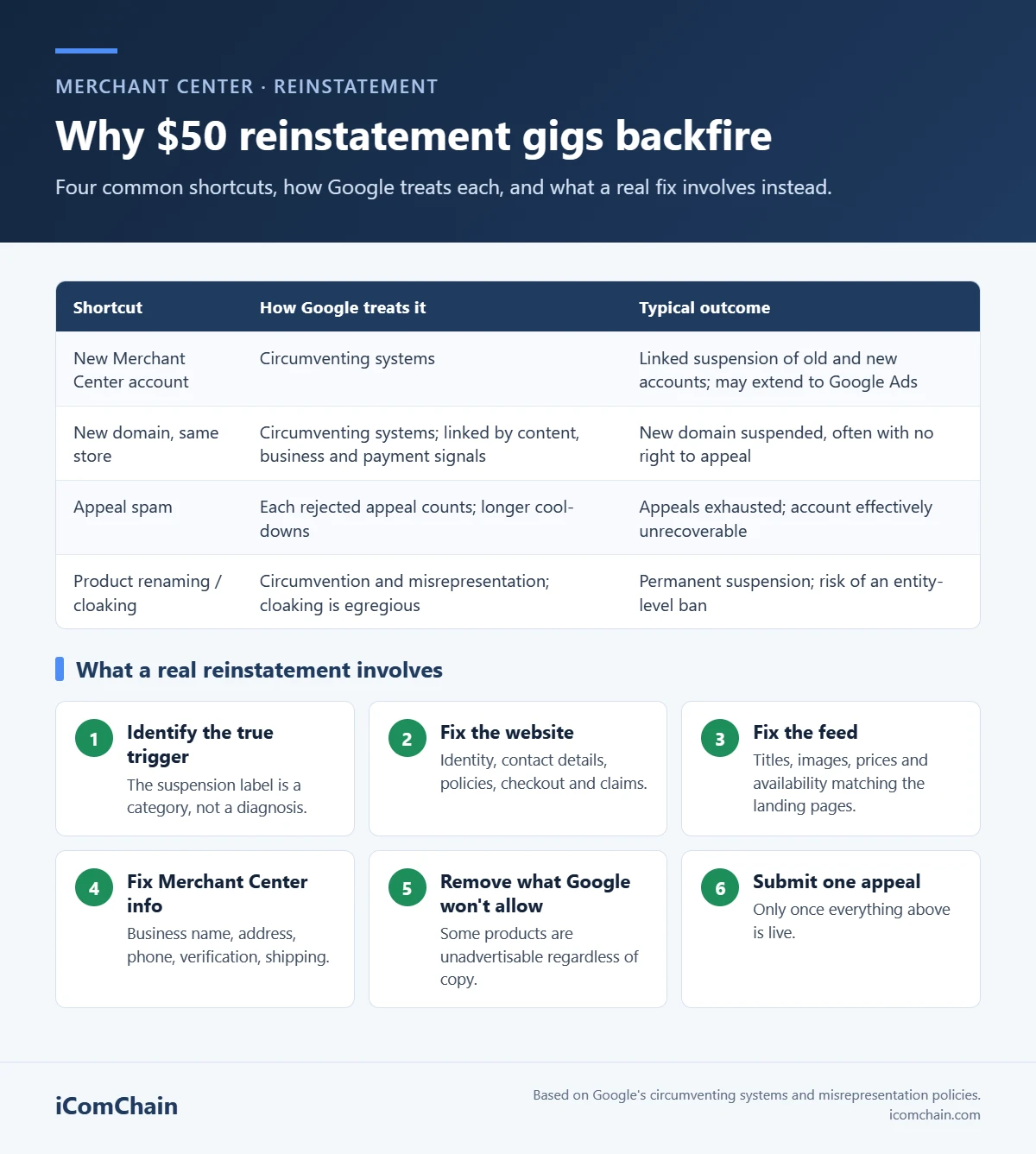
| Shortcut | What it looks like | How Google treats it | Typical outcome |
|---|---|---|---|
| New Merchant Center account | “We’ll set you up a fresh account” under a new email or a contractor’s business | Circumventing systems: creating accounts to get around enforcement | Linked suspension of old and new accounts; may extend to Google Ads |
| New domain, same store | Catalogue moved to a slightly different domain; old domain redirected or left up | Circumventing systems; Google links by content, business and payment signals | New domain suspended, often with no right to appeal |
| Appeal spam | Template appeals submitted repeatedly without site changes | Each rejected appeal counts; repeat requests can lead to longer cool-downs | Appeals exhausted; account effectively unrecoverable |
| Product renaming / cloaking | “BPC-157” becomes “B-157 Research Compound”; claims hidden from Googlebot | Circumventing systems and misrepresentation; cloaking is egregious | Permanent suspension, risk of entity-level ban |
1. “We’ll give you a new account”
Google’s policies treat creating new accounts to get around a suspension, or using someone else’s account to keep advertising, as circumventing systems. It’s listed alongside cloaking as an egregious violation. Google links accounts through business identity, verification documents, payment methods, IP and device data, domains and product data. When the link is made, which in our experience is usually within days to weeks, the new account is suspended and the original account’s case is worse than before. Read why circumventing systems turns suspensions permanent.
2. “Just move to a new domain”
Same policy, different vehicle. A new domain with the same products, copy, images, business details and payment setup is trivially linkable. It is also one of the most common routes to an entity-level ban, where Google stops accepting the business across any account.
3. “We’ll appeal for you”
An appeal is a request for Google to re-review a store that you say is now compliant. If nothing has changed, it fails. Google’s own help pages say accounts suspended for egregious violations are reinstated only in “compelling circumstances,” and merchants with several rejected appeals report longer waits before they can request review again. A template appeal on an unchanged site doesn’t just fail; it uses up credibility you’ll need later. See what to do after an appeal is denied.
4. “We’ll rename the products”
For peptide stores this usually means abbreviating or coding compound names, stripping claims from the feed while leaving them on the site, or showing reviewers different content from customers. Showing different content to Google than to users is cloaking. Renaming to slip a prohibited product past review is circumventing systems. Both are on Google’s list of violations that can lead to suspension without warning.
A merchant pays for a quick fix, gets a new account approved briefly, starts spending on Shopping, and is suspended again two to six weeks later, now with two accounts flagged, a domain linked to a circumvention finding, and no clear appeal path. Recovery at that stage, if possible at all, takes far longer than fixing the original issue would have.
Why appeals are a finite resource
Google doesn’t publish an exact appeal limit for Merchant Center, but its process is designed to reward evidence and punish repetition. In practice:
- The first appeal on a properly fixed store has the best chance.
- Each rejection makes the next reviewer more sceptical and can extend waiting periods.
- Egregious findings (circumvention, cloaking, unauthorised pharmacy) may come with no right to relist.
That’s why “we’ll keep appealing until it works” is not a strategy.
What a real reinstatement involves
- Identify the true trigger. The suspension label (misrepresentation, unapproved substances, website needs improvement, untrustworthy promotions) is a category, not a diagnosis. Use our 60-second diagnostic hub as a starting point.
- Fix the website. Business identity and contact details, return and shipping policies, checkout, product claims, and content that contradicts what you sell. See the pages you need to pass review.
- Fix the feed. Titles, descriptions, images, prices and availability that exactly match the landing pages.
- Fix Merchant Center information. Business name, address, phone, verification, and payment and shipping settings that match the site.
- Remove anything Google simply won’t allow. For peptide stores, some products are unadvertisable on Google regardless of copy. An honest specialist will tell you which.
- Submit one appeal once everything above is live, with a clear explanation of what changed.
Done properly, that’s days of work, not minutes. It’s why credible reinstatement work costs more than a gig. Ours is a flat $1,500 with a typical 7–14 day turnaround; see Merchant Center recovery.
How to vet anyone you hire, including us
- Asks for access to your site, feed and Merchant Center diagnostics before quoting.
- Explains which policy they think was triggered and why.
- Tells you which products Google won’t accept at all.
- Refuses to open new accounts or move domains as a “fix.”
- Gives a written list of changes before any appeal is submitted.
- Guaranteed approval within 24–48 hours.
- “We have a special contact at Google.”
- Offers a new or “aged” Merchant Center account.
- Suggests code names for your products.
- Wants to submit an appeal before changing anything.
15 questions answered
Can I just open a new Merchant Center account after a suspension?
Not legitimately. Google treats creating new accounts to get around a suspension as circumventing systems, an egregious violation that can lead to permanent suspension of all linked accounts.
Will moving my store to a new domain fix a suspension?
No. Google links stores by business, content, product and payment signals. A new domain with the same business is a common route to a circumvention finding and an entity-level ban.
How many times can I appeal a Merchant Center suspension?
Google doesn’t publish a fixed number, but repeated rejected appeals reduce credibility and can extend waiting periods. Egregious violations may carry no right to relist. Treat your first appeal as the one that matters.
Do people really have contacts inside Google who can reinstate accounts?
Claims like this are a red flag. Reinstatement decisions go through Google’s policy review process. Nobody legitimate sells privileged access.
Is renaming peptide products allowed?
Renaming products to avoid detection of a prohibited product is circumventing systems. Accurate, scientific product naming for genuinely permitted products is fine; disguising what something is is not.
What is cloaking in Merchant Center?
Showing Google’s reviewers or crawlers different content from what users see, for example a clean feed and landing page for review while claims appear elsewhere. It’s treated as an egregious violation.
Why is credible reinstatement work more expensive?
Because it requires diagnosing the trigger and changing the website, feed and business information, which is days of skilled work, before a single, well-evidenced appeal.
How long does a proper reinstatement take?
For most of our cases, 7–14 days from start to decision. Complex or previously failed cases take longer.
Can an account suspended for circumventing systems be recovered?
Sometimes, but it’s much harder. Google reinstates egregious violations only in compelling circumstances. The earlier you stop the circumvention and fix the underlying issue, the better the odds.
Can a freelancer’s new account get my Google Ads suspended too?
Yes. Google links Merchant Center and Ads accounts through shared business and payment data, and circumvention findings can extend across products.
What does an “aged” Merchant Center account mean?
An older account being resold or reused for a different business. Using someone else’s account to advertise your business violates Google’s policies and is a circumvention risk.
Should I pay for a guaranteed reinstatement?
No one can guarantee Google’s decision. Guarantees usually signal tactics that bypass review rather than pass it.
What if a cheap fix already got me a second suspension?
Stop using any new or linked accounts, document what was done, and fix the original issues before any further appeal. Read our guide on repeated violations and entity bans.
Can peptide stores be reinstated at all?
Some can, depending on the products and how the store is positioned. Many peptides are unadvertisable on Google regardless of copy. A credible specialist will tell you upfront.
What does iComChain charge?
Merchant Center reinstatement is a flat $1,500. We also offer a $149 self-run audit if you want to diagnose the issues yourself first.
Already tried a quick fix?
Book a 15-minute call. We’ll look at your account history and tell you honestly whether it’s recoverable and what it will take.
Sources
- Google Merchant Center Help: Misrepresentation
- Google Ads Policy Help: Circumventing systems
- Google Merchant Center Help: Healthcare and medicines (enforcement and appeals)
General information only. iComChain is not affiliated with Google. Examples describe patterns reported to us by merchants; they are not claims about any specific freelancer. Facts reflect public sources available on 22 October 2026.