What’s inside
The email usually arrives on a Friday. Your Stripe, PayPal, Square or Shopify Payments account has been closed for a policy violation, payouts are paused, and your checkout now fails. Most of the advice online about this moment is written by high-risk processors selling their own gateway. This guide covers the payment side too, but it also covers the part they leave out: how the switch affects your Google Merchant Center account and your ads.
Why processors shut down peptide stores
Mainstream payment facilitators approve merchants quickly and review them later. Peptide stores tend to pass sign-up and fail the later review. The reasons cited by processors and by industry write-ups are consistent:
- Acceptable-use policies. Stripe’s restricted-business list does not name peptides, but prohibits products “frequently associated with illegal activity” and gray-area categories, and that is where research peptides are placed. PayPal and Square are widely reported to prohibit them. Shopify Payments is powered by Stripe, so the same rules apply.
- Automated monitoring. Risk models scan product names, descriptions, transaction patterns and news mentions. A product page that mentions dosing or a named GLP-1 can trigger review without a human ever looking.
- Chargebacks. Peptide merchants often run above-average dispute rates, especially from “friendly fraud” and shipping delays.
- Regulatory signals. FDA’s August 2026 warning letters to online peptide sellers were public and widely covered. Processors read the same news. See what to do if you receive an FDA letter.
What happens to your money
| Question | What typically happens |
|---|---|
| New payments | Stop immediately on termination |
| Balance and pending payouts | Held in reserve, commonly reported at 90–180 days, to cover refunds and chargebacks |
| After the hold | Remaining funds are usually released, minus any chargebacks and fees |
| Subscriptions / saved cards | Card tokens generally cannot be moved off the old processor without its cooperation |
| MATCH (Terminated Merchant File) | A card-network list of terminated merchants that can make approvals harder for years. Not every termination results in listing; ask the processor directly |
Do not open a new account with the same processor under another name, or route payments through a friend’s account or a different aggregator while the old account is under review. Processors link accounts by identity, bank and device signals, and this is how a recoverable termination becomes a MATCH listing.
The first 72 hours, hour by hour
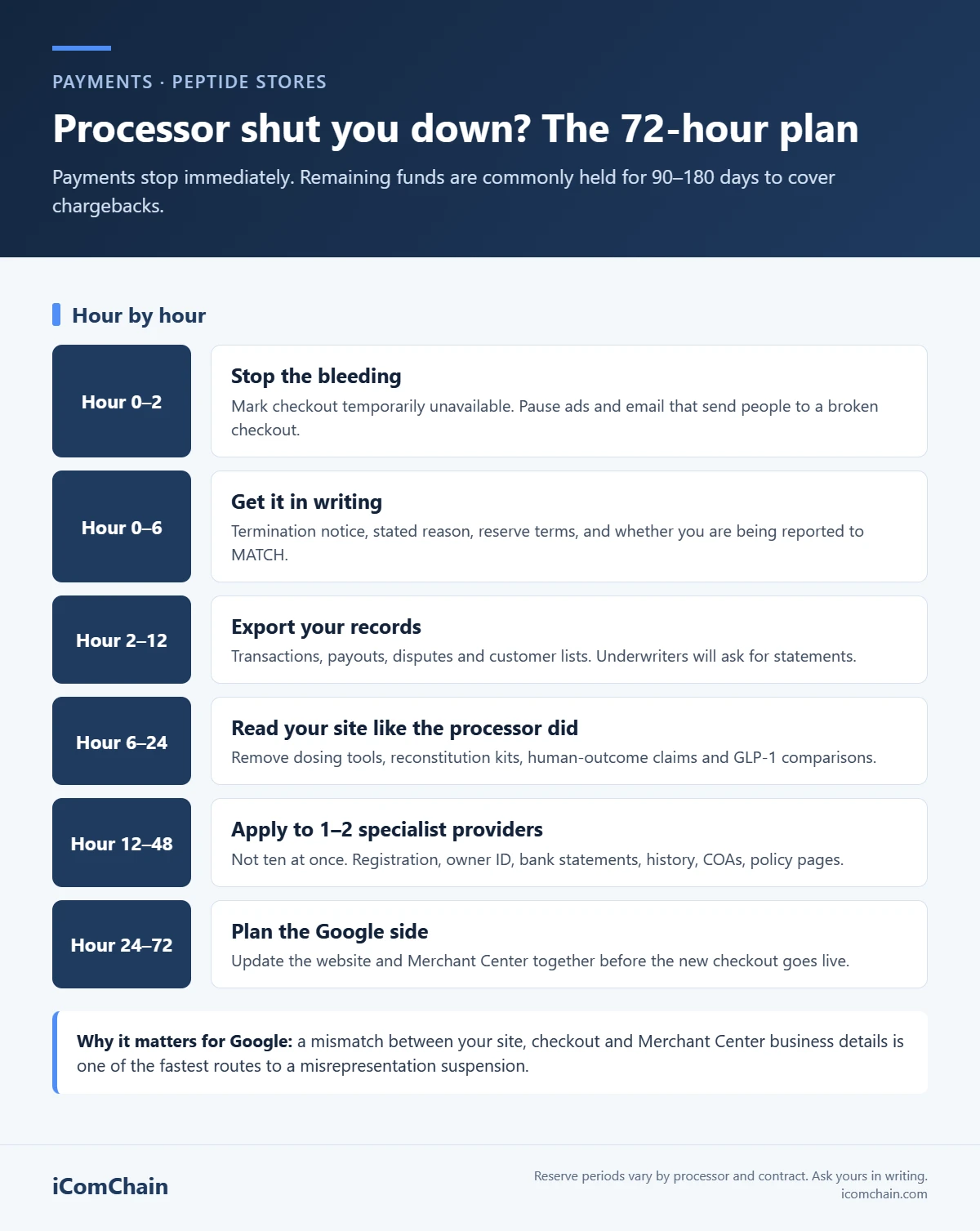
- Hour 0–2: Stop the bleeding. Put the store in a clear “checkout temporarily unavailable” state, or switch to manual invoicing for existing B2B customers. Pause Google Ads and email campaigns that send people to a broken checkout; you are paying for clicks that cannot convert.
- Hour 0–6: Get it in writing. Download the termination notice, the stated reason, and any reserve terms. Ask the processor in writing how long funds will be held and whether the account is being reported to MATCH.
- Hour 2–12: Export your records. Transaction history, payout reports, dispute history and customer lists. Every high-risk underwriter will ask for recent processing statements.
- Hour 6–24: Read your own site the way the processor did. The same issues that get stores shut down also get them declined by the next processor. Remove dosing tools, reconstitution kits, human-outcome claims and GLP-1 comparisons. Our website audit checklist lists what to look for.
- Hour 12–48: Apply to one or two specialist providers. Not ten at once. Prepare business registration, owner ID, bank statements, processing history, product list with COAs, and your website’s terms, refund and privacy pages.
- Hour 24–72: Plan the Google side. Before the new checkout goes live, decide what changes on the website, and update Merchant Center at the same time. See the section on Google below.
Choosing the next processor
High-risk processors and merchant-account brokers will approve many peptide businesses that Stripe will not, but on different terms. Typical figures published by providers in 2026 are processing rates of roughly 3.5–5.5% and rolling reserves of 5–10% of monthly volume held for 90–180 days. Treat any provider’s numbers as marketing until you see a contract.
Questions to ask before you sign
- Is this a dedicated merchant account underwritten for my business, or another aggregator account that can be closed the same way?
- Which acquiring bank sits behind it, and does it knowingly accept research peptides?
- What are the reserve, hold period and early-termination terms, in writing?
- What website requirements do you check, and how often do you re-review?
- Do you support ACH or bank-transfer alternatives for B2B customers?
- What happens if my chargeback ratio rises: warning period or immediate termination?
Some processors require LegitScript certification. LegitScript certifies healthcare merchants such as pharmacies and telehealth providers and supplement companies; it is not a route for selling unapproved peptides to consumers. Read LegitScript certification for peptides before you pay an application fee.
Why your processor change can trigger a Google suspension
This is the part payment providers don’t mention. Google Merchant Center checks that your website, checkout and account information are consistent and trustworthy. A rushed processor switch often breaks that in several ways at once:
- Checkout failures during review. Google’s reviewers, human and automated, test whether products can actually be bought. A dead or erroring checkout reads as an untrustworthy store.
- Payment methods on the site don’t match reality. Card logos in the footer for cards you no longer accept are a small but real misrepresentation signal.
- Business name on statements changes. If the descriptor or legal entity changes, your Merchant Center business information, website contact page and policies must change too.
- Redirecting checkout to another domain. Some high-risk setups send buyers to an external payment page. If that domain looks unrelated to your store, Google may treat it as a mismatch. Make the hand-off clearly branded and disclosed.
- Crypto-only or “contact us to pay”. Stores with no standard checkout often fail Google’s site requirements outright.
- Pause Shopping and Performance Max while checkout is broken rather than let Google review a store that can’t sell.
- Update the site first: payment logos, checkout flow, refund policy (if the new processor changes refund handling), and legal entity details.
- Update Merchant Center business information to match exactly.
- Test a full purchase on desktop and mobile, then resume ads.
If you are already suspended, our Merchant Center recovery service handles the diagnosis and appeal for a flat $1,500.
Preventing the next shutdown
- Run two processors from day one, with traffic split, so one closure doesn’t stop revenue.
- Keep the site clean: no dosing, calculators, reconstitution kits or outcome claims. Re-audit every quarter.
- Manage disputes: clear billing descriptor, fast shipping updates, accessible refund policy. Industry case studies cite keeping chargebacks under about 1% as a practical target.
- Stay honest in underwriting. Describe exactly what you sell. Accounts approved on a vague description are the ones closed later.
- Keep marketing consistent with what you told the processor: ads, email and affiliates included. See payment processors that accept peptide brands.
16 questions answered
Why did Stripe close my peptide store if peptides aren’t on their banned list?
Stripe’s restricted-business list prohibits products frequently associated with illegal activity and gray-area categories rather than naming every product. Research peptides are commonly treated as falling within those categories, especially when sites show human-use signals.
How long will my funds be held?
Industry reports commonly cite 90–180 days after termination, depending on the processor and your dispute history. Ask the processor in writing for its specific terms.
Will I get my money back?
Usually most of it, after the hold period, minus refunds, chargebacks and fees that arise during the hold. Funds can be reduced further if disputes spike.
What is the MATCH list?
MATCH, also called the Terminated Merchant File, is a card-network database of merchants terminated for certain reasons. Being listed makes new approvals much harder for several years. Not every termination leads to a listing.
Can I appeal a Stripe or PayPal termination?
You can ask for a review, and it is worth doing if the closure was based on a misunderstanding. If the products themselves fall within the processor’s prohibited categories, reversals are rare.
Can I just open a new account?
No. Opening a new account with the same processor after termination usually violates its terms and is a common path to MATCH listing. Processors link accounts through identity, bank and device data.
Does Shopify Payments allow peptides?
Shopify Payments runs on Stripe, so Stripe’s restrictions apply. Shopify also has its own acceptable-use policy. Many peptide stores move to WooCommerce for platform flexibility; see e-commerce platforms for peptides.
What do high-risk processors charge?
Providers publish rates around 3.5–5.5% plus rolling reserves of 5–10% held 90–180 days for peptide accounts. Actual terms depend on your volume, history and products.
What documents will a new processor ask for?
Typically business registration, owner identification, bank statements, recent processing statements, the termination notice, a product list with certificates of analysis, and live refund, privacy and terms pages.
Do I need LegitScript to get a processor?
Some processors require it. LegitScript certifies pharmacies, telehealth providers and supplement companies under its standards; it does not certify the sale of unapproved peptides to consumers.
Can a processor change cause a Merchant Center suspension?
Yes. A broken checkout during review, outdated payment logos, changed business details or an unexplained redirect to another payment domain can all lead to misrepresentation or site-quality suspensions.
Should I pause Google Ads after a processor shutdown?
Yes, for any campaigns sending traffic to a checkout that cannot take payment. You waste spend and risk Google reviewing a store that cannot complete a purchase.
Is crypto checkout a solution?
It can work as a supplementary method, but a crypto-only store usually fails Google Merchant Center’s requirements and reduces conversion for most buyers.
Is ACH a good alternative?
For B2B and repeat customers, ACH or bank transfer can reduce chargebacks and processor risk. It adds friction for first-time buyers, so it works best alongside card processing.
How do I avoid the next shutdown?
Run two processors, keep the site free of human-use signals, manage disputes actively, and describe your business honestly in underwriting so the account isn’t approved on a basis it can’t keep.
Can iComChain help with payments?
We are not a payment provider. We help with the parts that decide whether the next processor and Google approve you: website compliance, checkout, consistency between site, feed and Merchant Center, and suspension recovery.
Processor gone and Merchant Center at risk?
Book a 15-minute call. We’ll check what your site, checkout and Merchant Center are showing Google right now and what to change before you switch on the new processor.
Sources
- Stripe: Restricted businesses list
- Vector Payments: Why processors shut down peptide businesses (vendor content)
- InclusivePay: Stripe, PayPal and Square ban peptides (vendor content)
- Google Merchant Center Help: Misrepresentation
- Google Merchant Center Help: Shopping policies
General information only, not financial or legal advice. iComChain is not a payment processor and receives no commission from any provider mentioned. Research-use-only (RUO) products are intended for laboratory research only and not for human consumption. Facts reflect public sources available on 22 October 2026.