What’s inside
Within hours of the PCAC vote, social feeds filled with “BPC-157 is legal now” posts. It isn’t, and brands that change their marketing on that assumption are walking into exactly the kind of website evidence FDA cited in its August 2026 warning letters. Here is what the vote really did, based on the meeting coverage and legal analyses, and what it means for anyone advertising in this space.
What happened at the July 2026 meeting
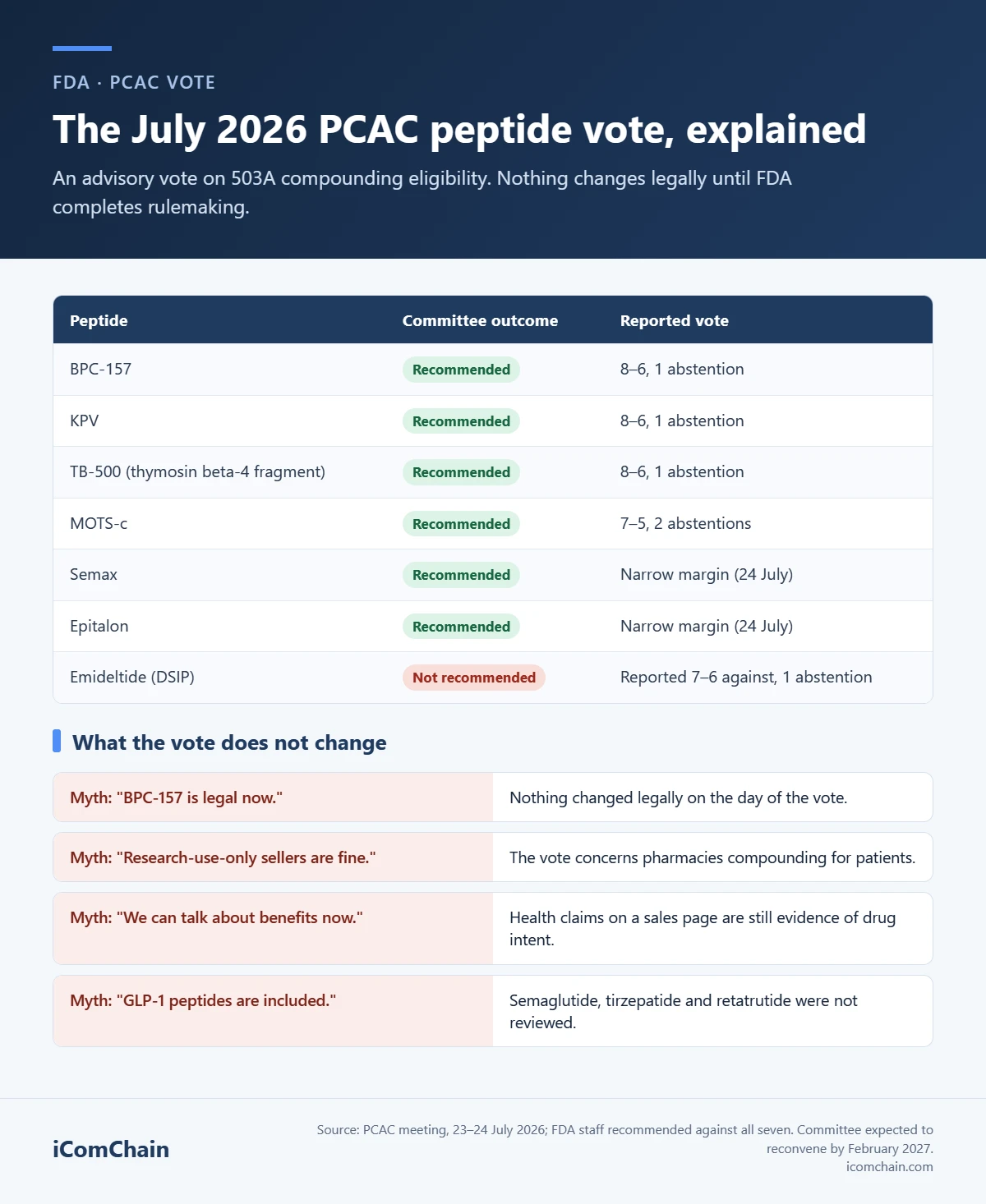
The PCAC met on 23 and 24 July 2026 to reconsider seven peptides that had been removed from compounding eligibility in 2023. FDA’s own scientific staff recommended against all seven, citing thin human data and unresolved impurity and immunogenicity concerns. The committee disagreed on six.
| Peptide | Committee outcome | Reported vote |
|---|---|---|
| BPC-157 | Recommended | 8–6, 1 abstention |
| KPV | Recommended | 8–6, 1 abstention |
| TB-500 (thymosin beta-4 fragment) | Recommended | 8–6, 1 abstention |
| MOTS-c | Recommended | 7–5, 2 abstentions |
| Semax | Recommended | Narrow margin (24 July) |
| Epitalon | Recommended | Narrow margin (24 July) |
| Emideltide (DSIP) | Not recommended | Reported 7–6 against, 1 abstention |
Coverage described the six recommendations as an unusual outcome given staff advice. The committee is expected to reconvene before the end of February 2027 to review further peptides.
What the 503A bulks list actually is
Section 503A of the FD&C Act lets licensed pharmacies compound medicines for individual patients with a prescription, using bulk drug substances that meet certain criteria. One route is the “503A bulks list.” Being on it means a licensed pharmacy may compound the substance for a specific patient with a valid prescription.
It does not mean the substance is FDA-approved, proven safe or effective, or available without a prescription. And to get on the list, FDA has to:
- Decide whether to accept the committee’s non-binding recommendation.
- Publish a proposed rule.
- Run a public comment period.
- Publish a final rule.
Legal analyses note that this commonly takes months and can take years. Until a final rule, compounding these peptides remains prohibited. Some states, including Alabama, Ohio, California and New York, take stricter positions on peptide compounding regardless of federal changes.
What the vote does not change
- “BPC-157 is legal now.” No. Nothing changed legally on the day of the vote.
- “So research-use-only sellers are fine.” No. The vote concerns pharmacies compounding for patients. FDA’s August 2026 warning letters show it is actively pursuing online sellers whose sites indicate human use.
- “We can talk about benefits now.” No. Health claims on a sales page are still evidence of drug intent. A favourable committee vote is not evidence of safety or efficacy.
- “GLP-1 peptides are included.” No. Semaglutide, tirzepatide and retatrutide were not part of this review. They featured heavily in the 2026 warning letters.
A pharmacist writing in Pharmacy Times summed it up plainly: nothing a patient can legally obtain from a compounding pharmacy changed because of the vote.
What it means for Google Ads and Merchant Center
Google’s policies don’t track advisory committee votes. They prohibit unapproved pharmaceuticals and supplements “regardless of any claims of legality,” and allow prescription drugs only for certified online pharmacies in permitted countries. Practically:
- For research-use-only sellers: nothing changes. Listings for these peptides remain high-risk for disapproval and suspension. See Google Ads policy for peptides.
- For compounding pharmacies and telehealth: if and when a final rule lists a peptide, advertising compounded prescription products still requires the right certifications (for example, Google’s online pharmacy certification after accreditation by LegitScript or NABP) and compliance with prescription-drug advertising rules. See LegitScript for peptides.
- For everyone: don’t rewrite landing pages around the vote. “FDA panel backs BPC-157” headlines on a product page are a health-claim magnet for Google’s reviewers.
How peptide brands should plan for 2027
- Decide which business you are. A genuine research supplier, a pharmacy/telehealth operator, or a consumer brand. Only the first two have a compliant future, and they look very different.
- If you’re research supply, keep your site free of human-use signals and ignore the vote in your marketing. Use our website audit checklist.
- If you’re moving toward pharmacy or telehealth, start accreditation and certification planning now. Those processes take months and will matter if any final rule lands.
- Watch for the proposed rule in the Federal Register and the February 2027 PCAC meeting.
- Diversify channels. Organic search and email are less exposed to sudden policy enforcement. See peptide SEO and where to advertise peptides.
15 questions answered
Is BPC-157 legal after the July 2026 vote?
No change took effect. The PCAC recommendation is advisory. BPC-157 can only be compounded by pharmacies under 503A once FDA accepts the recommendation and completes rulemaking. It is not FDA-approved.
Which peptides did the PCAC recommend?
BPC-157, KPV, TB-500, MOTS-c, Semax and Epitalon. Emideltide (DSIP) was not recommended.
When will the peptides be added to the 503A bulks list?
There is no set date. FDA must accept the recommendations and complete a proposed rule, comment period and final rule. Legal commentators suggest this could extend into 2027 or 2028.
Did FDA staff agree with the committee?
No. FDA staff recommended against all seven peptides, citing limited human data and safety concerns. The committee’s majority disagreed on six.
Does the vote affect research-use-only sellers?
Not directly. It concerns licensed pharmacies compounding for prescribed patients. FDA’s August 2026 warning letters show continued enforcement against online sellers whose websites indicate human use.
Can I now advertise BPC-157 on Google?
Google’s policies are unchanged by the vote. Unapproved substances remain prohibited regardless of claimed legality, and prescription products require pharmacy certification.
Were GLP-1 peptides part of the vote?
No. Semaglutide, tirzepatide, retatrutide and other GLP-1 compounds were not reviewed. Several were named in the August 2026 warning letters.
What is the 503A bulks list?
A list of bulk drug substances that licensed pharmacies may use to compound medicines for individual patients with a valid prescription under section 503A of the FD&C Act.
Does being on the 503A list mean a peptide is safe?
No. Listing allows pharmacy compounding under prescription; it is not FDA approval and not a finding of safety or effectiveness.
What happens at the February 2027 PCAC meeting?
The committee is expected to review additional peptides. Outcomes, like July’s, would be advisory and would still need rulemaking.
Do state laws matter?
Yes. Several states, including Alabama, Ohio, California and New York, take stricter positions on peptide compounding regardless of federal changes.
Should I mention the PCAC vote on my product pages?
We advise against it. Using the vote to imply legitimacy or benefits is likely to be read as a health claim by both regulators and Google’s reviewers.
Could a telehealth company advertise compounded BPC-157 in future?
Potentially, if a final rule lists it and the company holds the necessary accreditation and Google pharmacy certification and follows prescription advertising rules. That is a future scenario, not today’s reality.
What’s the safest marketing strategy right now?
Accurate positioning for your genuine business model, clean websites free of human-use claims, and channel diversification beyond paid platforms.
Can iComChain help us prepare?
Yes. We help brands align websites, feeds and campaigns with their real business model and plan certification routes, alongside their regulatory counsel.
Planning your 2027 strategy?
Book a 15-minute call. We’ll look at your products, positioning and channels and tell you what’s realistic on Google next year.
Sources
- AJMC: FDA panel backs 6 peptides for compounding (31 July 2026)
- Pharmacy Times: What the peptide vote actually changes
- Sheppard Mullin: FDA balances peptide policy with enforcement
- Bass, Berry & Sims: FDA advisory committee recommends six peptides
- Google Merchant Center Help: Healthcare and medicines
General information only, not legal, regulatory or medical advice. None of the peptides discussed are FDA-approved for the uses commonly marketed online. Research-use-only (RUO) products are intended for laboratory research only and not for human consumption. Facts reflect public sources available on 22 October 2026.