What’s inside
When FDA’s Office of Unapproved Drugs and Labeling Compliance reviewed online peptide sellers in July 2026, it did not buy products or test them. It read their websites. The letters it issued on 24 August 2026 quote product pages, blogs, FAQs and tools back to the companies as proof that the products were intended for people. That makes the website audit the single most useful compliance exercise a peptide brand can do this quarter.
This audit shows what regulators and platforms read as evidence of human use. It is not a guide to hiding human use. If your real customers are individuals buying peptides to use on themselves, removing words does not make that lawful; it just removes the evidence while the conduct continues, which makes things worse if it is discovered. Use this to check that a genuine laboratory-supply business is presenting itself accurately, and talk to regulatory counsel about anything else.
Why your website is the whole case
Under the Federal Food, Drug, and Cosmetic Act, whether a product is a “drug” depends on its intended use, and intended use can be shown by the seller’s own statements and circumstances of sale. FDA treats website content as labeling. In the 2026 letters it cited section 201(g)(1) for intended use and section 505(a) for marketing an unapproved new drug, and said the products were misbranded because they lacked adequate directions for safe use by a layperson.
The practical effect: a “research use only” line in the footer is one piece of evidence, and everything else on the site is weighed against it. Sheppard Mullin’s analysis of the letters notes that the disclaimers did not protect any of the recipients.
The 10 elements FDA cited, and what each one signals
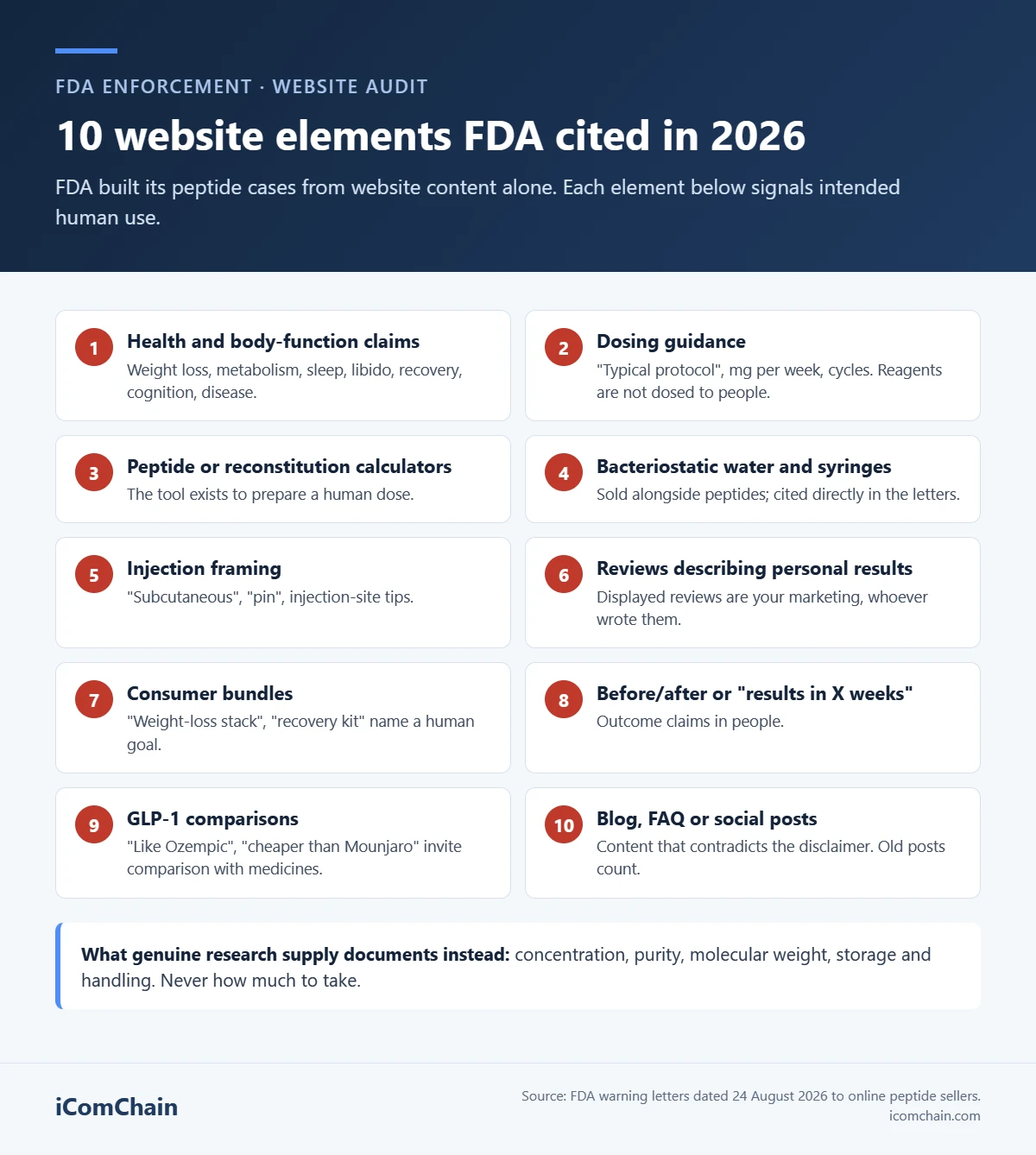
| # | Element on the site | Why it signals human use | Seen in 2026 letters? |
|---|---|---|---|
| 1 | Claims about weight loss, appetite, metabolism, energy, sleep, libido, recovery, cognition, organ protection or disease | Describes an effect in a person’s body: the textbook definition of a drug claim | Yes, extensively |
| 2 | Dosing guidance (“typical protocol”, mg per week, cycles) | Laboratory reagents are not dosed to people | Yes (guides) |
| 3 | Peptide or reconstitution calculators | Tool exists to prepare a human dose | Yes |
| 4 | Bacteriostatic water and syringes sold alongside peptides | Shows the buyer is expected to reconstitute and inject | Yes, cited directly |
| 5 | Injection framing (“subcutaneous”, “pin”, injection-site tips) | FDA singled out injectables for heightened concern | Yes |
| 6 | Customer reviews describing personal results | Displayed reviews are your marketing, whoever wrote them | Pattern consistent with letters |
| 7 | Consumer bundles (“weight-loss stack”, “recovery kit”) | Names a human goal, not a research application | Pattern consistent with letters |
| 8 | Before/after or “results in X weeks” language | Outcome claims in people | Pattern consistent with letters |
| 9 | GLP-1 positioning against approved drugs (“like Ozempic”, “cheaper than Mounjaro”) | Invites comparison with prescription medicines | GLP-1 products named in every letter |
| 10 | Blog, FAQ or social posts that contradict the disclaimer | Content is labeling; old posts count | Yes (website content broadly) |
1. Health and body-function claims
The letters list claims about weight loss, metabolism, appetite suppression, mitochondrial function, growth hormone signalling, sexual dysfunction and arousal, bone health, neuroprotection, kidney protection, cancer, fatty liver disease and cognition. Note that many of these were phrased as “research suggests” or “studies show.” Citing research about effects in people is still a claim about effects in people when it sits on a sales page.
2 and 3. Dosing guides and calculators
FDA explicitly treated peptide guides and calculators as support for human injectable use. A genuine reagent supplier documents concentration, purity, molecular weight, storage and handling. It does not tell anyone how much to take.
4 and 5. Reconstitution supplies and injection language
This is the clearest new signal from 2026. Bacteriostatic water sold next to lyophilised peptides was cited in multiple letters as evidence of combined intended use. FDA also stressed that injectables are especially concerning because injection bypasses the skin’s protective barrier.
6, 7 and 8. Reviews, bundles and results language
Reviews you choose to display, bundle names and outcome language all describe what customers do with the product. These are the same signals Google’s Merchant Center reviewers use when deciding whether a store is misrepresenting what it sells.
9. GLP-1 positioning
Semaglutide and tirzepatide are approved prescription medicines in the US. Retatrutide, survodutide and mazdutide are investigational. All appeared in the 2026 letters. Positioning any of them as an alternative to a branded medicine is about as direct a drug claim as exists. See why GLP-1 listings get Merchant Center suspended.
10. Content that contradicts the disclaimer
Old blog posts are the most common surprise in our audits. A product page may have been cleaned up a year ago while a 2024 post about “the best peptide for fat loss” still ranks and links to it.
What genuine research-supply positioning looks like
For a business that actually sells to laboratories, the site should look like a reagent catalogue, because that is what it is. Industry guidance from high-risk payment underwriters converges on the same elements:
- Scientific product data: sequence, molecular weight, CAS number where applicable, purity method, lot number, storage conditions.
- Lot-specific certificates of analysis from an independent lab. See COAs and third-party testing.
- “For laboratory research use only” on every product page, not just in the footer, plus terms of sale that restrict purchase to research use.
- Account or purchase flows appropriate to institutional and B2B buyers.
- No reconstitution kits, dosing tools, human outcome claims or consumer bundles anywhere on the domain.
- Business identity, address and contact details that match your Merchant Center and processor records.
If that description doesn’t match your actual customers, the gap is the risk, not the copy.
The same audit through Google’s eyes
Google reached similar conclusions years before FDA’s 2026 sweep. Its Merchant Center Healthcare and medicines policy prohibits unapproved pharmaceuticals and supplements “regardless of any claims of legality,” products claiming prescription-level effects, and products subject to regulatory action. Google’s reviewers, and increasingly its automated AI review, read the whole site. Our guide to the AI Merchant Center review explains how.
- Elements 1, 8 and 9 map to Google’s “unapproved substances” and “unapproved claims” rules.
- Elements 6, 7 and 10 are classic causes of misrepresentation suspensions because the site says something different from the feed.
- Element 4 commonly causes product disapprovals on the supplies themselves.
How to run the audit in an afternoon
- Crawl the whole domain (Screaming Frog or similar) and export every indexable URL, including blog, tag and old campaign pages.
- Search the crawl for trigger terms: dose, dosage, mg/week, cycle, protocol, inject, subcutaneous, reconstitute, bacteriostatic, fat loss, weight loss, appetite, libido, recovery, healing, anti-aging, results, before and after, Ozempic, Wegovy, Mounjaro.
- Review product data: titles, descriptions, bundle names, image alt text, structured data and the Merchant Center feed export.
- Review reviews: every displayed customer review and Q&A.
- Check what else links in: email archives, social profiles and affiliate pages that point to the site.
- Document what you change, with dates, so counsel and platform appeals have evidence.
Our $149 Merchant Center suspension audit automates the Google-facing part of this and returns a scored report.
15 questions answered
Did FDA test any products before issuing the 2026 letters?
According to the public letters and legal analyses, no. FDA reviewed the companies’ websites in July 2026 and based the letters on that content.
Is “research suggests” language safe?
Not when it describes effects in people on a page that sells the product. Framing a human-effect claim as a study summary does not change what it communicates about intended use.
Can I keep a blog about peptide research?
A blog that discusses laboratory research methods is different from one that discusses human results. Posts describing human outcomes, dosing or protocols, especially those linking to product pages, are content FDA treats as labeling.
Why is selling bacteriostatic water a problem?
FDA treated it, when sold alongside injectable peptides, as evidence the buyer would reconstitute and inject the product, and treated the water itself as part of the drug offering.
Are peptide calculators allowed?
FDA cited calculators as support for human injectable use in the 2026 letters. A tool that calculates a human dose is inconsistent with research-only positioning.
Do customer reviews count against me if customers wrote them?
Reviews you display on your site are part of your marketing. If they describe personal use and results, they communicate intended use regardless of who wrote them.
Is a footer disclaimer enough?
No. None of the 2026 recipients were protected by their disclaimers. Product-page disclaimers help consistency but cannot override contrary content.
Does this apply to UK and EU sites too?
The legal tests differ, but the UK MHRA has said that products carrying medicinal claims are treated as medicines under the Human Medicines Regulations 2012. See our UK and EU guide.
Will cleaning up my site get my Merchant Center account reinstated?
It is a prerequisite, not a guarantee. Google also checks feed accuracy, business identity and whether the products are permitted at all. Many peptides remain unadvertisable on Google regardless of copy.
Which trigger words matter most?
Dosing terms, injection terms, reconstitution terms, body-outcome terms (weight loss, recovery, libido, anti-aging) and comparisons to branded prescription drugs. The audit steps above include a starting list.
Should I delete old blog posts or edit them?
If you have received a letter, archive first and follow counsel’s direction. Otherwise, remove or rewrite content that describes human use, and redirect removed URLs to relevant pages so you are not leaving broken links.
Does the PCAC vote make BPC-157 claims acceptable?
No. The July 2026 PCAC recommendations are advisory, concern pharmacy compounding only, and require FDA rulemaking. They do not authorise consumer marketing. See our PCAC explainer.
What product information should a research supplier show?
Sequence, molecular weight, purity and method, lot number, storage and handling, and lot-specific third-party certificates of analysis. Not dosing or outcomes.
How often should I re-audit?
At least quarterly, and every time you launch products, run a campaign, add an affiliate or publish content. Most of the violations we find were added after an earlier cleanup.
Can iComChain do this audit for us?
Yes, on the Google, feed and site side. We audit and document changes and rebuild pages where the business model supports it. Legal conclusions remain with your counsel.
Want a second pair of eyes on your site?
We audit peptide and supplement stores against what Google’s reviewers and the 2026 letters actually flagged, and tell you what to change first.
Sources
- Sheppard Mullin analysis of the August 2026 peptide warning letters
- Analysis of FDA’s September 2026 peptide warning-letter sweep
- Google Merchant Center Help: Healthcare and medicines
- InclusivePay: website requirements cited by high-risk underwriters (vendor content)
- Patient Safety Learning: MHRA to investigate UK peptide clinics over health claims (April 2026)
General information only, not legal or regulatory advice. iComChain is a marketing and Merchant Center agency. Research-use-only (RUO) products are intended for laboratory research only and not for human consumption, diagnostic or therapeutic use. iComChain does not manufacture, sell or distribute peptides. Facts reflect public sources available on 22 October 2026.