What’s inside
With US enforcement tightening after FDA’s August 2026 warning letters, many American peptide and supplement brands are looking at the UK and Europe. We run a UK company ourselves and have taken a UK peptide brand from a suspended account to over £1M a month, so we see both sides. The short version: the UK and EU are not looser markets. They use different tests, and they are just as unforgiving of health claims.
How the UK and EU decide what’s a medicine
EU law (Directive 2001/83/EC) and the UK’s Human Medicines Regulations 2012 define a medicinal product in two ways. A product is a medicine if it meets either:
| Test | Question | What triggers it online |
|---|---|---|
| Presentation | Is it presented as treating or preventing disease in humans? | Health claims, dosing guidance, before/after, “for recovery”, “for weight loss”, comparisons with medicines |
| Function | Does it restore, correct or modify physiological functions by a pharmacological, immunological or metabolic action, or diagnose? | The substance itself; many peptides are designed to have pharmacological action |
The presentation test is the one most US sellers underestimate. Under it, even a product with weak pharmacological action can be classed as a medicine because of how the website describes it. And a product that meets the function test is a medicine however carefully it is presented.
What the MHRA said in 2026
In April 2026, following reporting by The Guardian, the MHRA said it would investigate whether UK clinics were breaking the law by making health claims about unregulated peptide treatments. Its stated position:
- Clinics are not permitted to make medicinal claims for the peptides they offer.
- If they do, “the products will be considered medicines and subject to regulation under the Human Medicines Regulations 2012.”
- The MHRA “will take action against clinics which are identified as breaching the legal requirements.”
The statement was about clinics, but the legal test is the same for online sellers: medicinal claims make the product a medicine. Selling or supplying an unlicensed medicine in the UK is a criminal offence. UK commentators throughout 2026 have described rising concern about peptides sold online, so expect more attention, not less.
Shipping peptides internationally means they pass through customs. UK Border Force and EU customs authorities can detain shipments they believe are unlicensed medicines. Talk to counsel and your logistics provider before launching, and don’t assume a US-compliant shipment is a UK-compliant one.
Merchant Center: country-by-country requirements
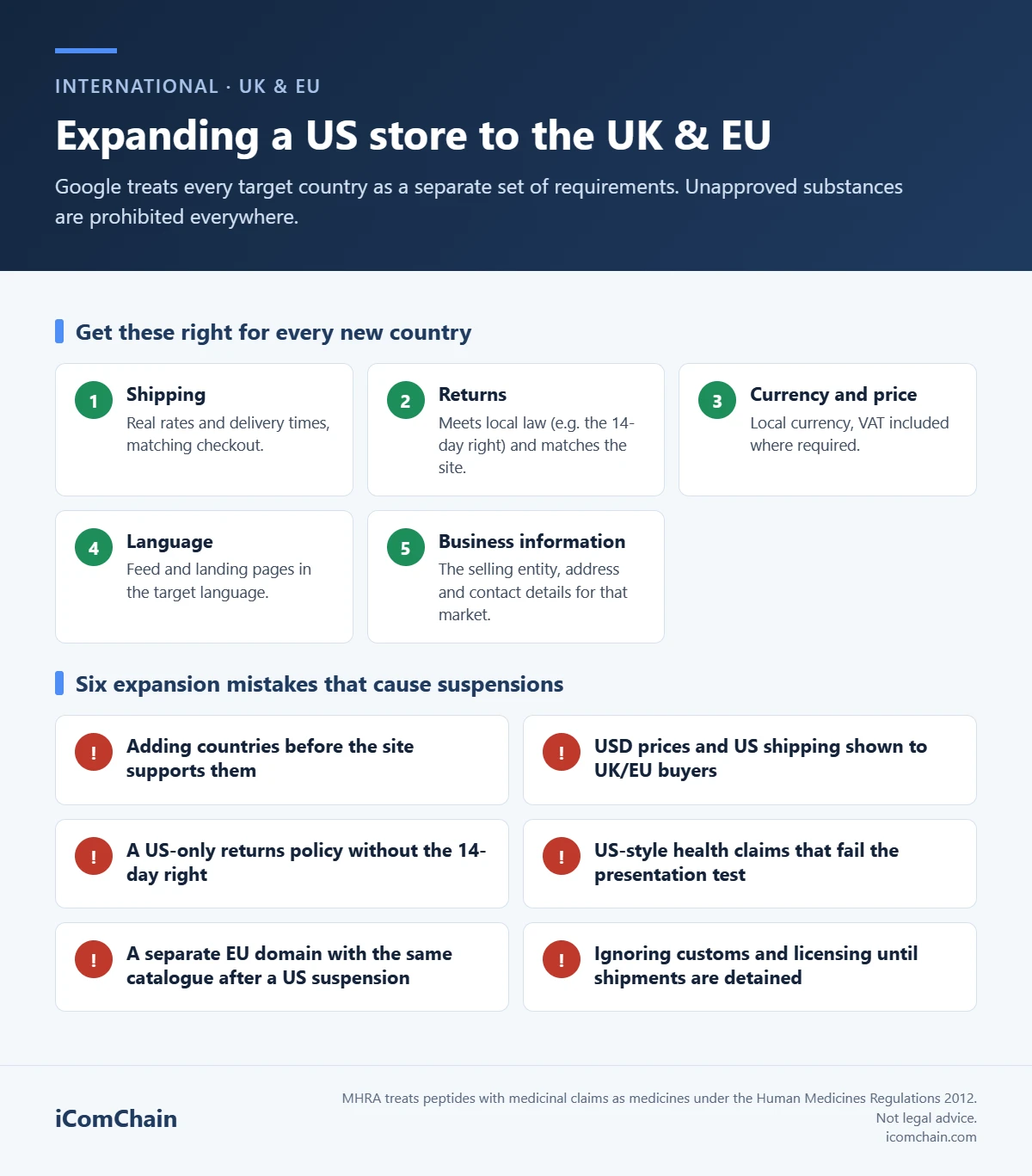
Google treats each country you target as a separate set of requirements. For healthcare-adjacent stores the key rules are:
- Prescription drugs: not allowed outside the US and, in limited cases, Canada.
- OTC medicines: in countries such as the UK, Germany and France, only certified online pharmacies meeting local registration may list them.
- Unapproved substances: prohibited everywhere, regardless of local claims of legality.
- Country-specific supplement and weight-loss limits exist in several markets.
Settings that must be right for every new country
- Shipping: real rates and delivery times to that country, matching what the site shows at checkout.
- Returns: a return policy that meets local law (see below) and matches the site.
- Currency and price: prices in the local currency where you target it, including VAT where required, matching the landing page.
- Language: feed and landing pages in the language you target.
- Business information: the selling entity, address and contact details customers in that country will deal with.
A US store that adds the UK and EU in Merchant Center without changing the site will typically show USD prices, US shipping and a US returns policy to European reviewers. That’s a fast route to a misrepresentation or website needs improvement suspension.
Consumer-law pages Google checks
Google’s reviewers expect store policies that make sense for the customer’s country. For the UK and EU that means at minimum:
- 14-day cancellation/withdrawal right for online consumer purchases (UK Consumer Contracts Regulations 2013; EU Consumer Rights Directive), with clear instructions.
- Full trader identity: legal name, geographic address, email; plus company number and VAT number where applicable.
- Clear total price including taxes and delivery before checkout.
- Privacy notice meeting UK GDPR / GDPR, and a cookie banner that lets users refuse non-essential cookies.
Our checklist of pages you need to pass Merchant Center review covers these in detail, and Google’s 2026 return policy rules add requirements of their own.
Do you need a UK or EU entity?
Not always, but it helps in practice. A local entity simplifies VAT registration, local payment processing, credible business identity for Google’s reviewers, and a local returns address. It does not change what you are allowed to sell. Discuss structure with an accountant and lawyer in each target market.
Six expansion mistakes that cause suspensions
- Adding countries in Merchant Center before the site supports them.
- Showing USD prices and US shipping to UK/EU buyers.
- A US-only returns policy without the 14-day right.
- Health claims written for a US audience that fail the presentation test.
- Using a separate domain for Europe with the same catalogue after a US suspension, which Google may treat as circumventing systems.
- Ignoring customs and licensing until shipments are detained.
15 questions answered
Are research peptides legal in the UK?
It depends on the product and how it is presented. If a peptide is presented with medicinal claims or functions as a medicine, it is a medicinal product under the Human Medicines Regulations 2012, and selling it without a licence is an offence. Take legal advice for your specific products.
What did the MHRA say about peptides in 2026?
In April 2026 it said it would investigate UK clinics making health claims for unregulated peptides, that such products “will be considered medicines,” and that it would take action against those breaching the law.
What is the presentation test?
A product is a medicine if it is presented as having properties for treating or preventing disease in humans. Website claims, dosing advice and comparisons with medicines can all satisfy it.
What is the function test?
A product is a medicine if it can restore, correct or modify physiological functions by pharmacological, immunological or metabolic action, or make a medical diagnosis, regardless of how it’s presented.
Can I sell prescription drugs to the UK through Google Shopping?
No. Merchant Center does not allow prescription drugs outside the US and, in limited cases, Canada.
Do I need to show prices in GBP and EUR?
If you target those countries in Merchant Center, the feed and landing page should show prices in the local currency including applicable taxes, and they must match.
What returns policy do UK and EU customers need?
A 14-day right to cancel online consumer purchases, with clear instructions and refund timelines, under UK and EU consumer law. Some exceptions apply, such as sealed goods unsealed for hygiene reasons.
Do I need a UK company to sell into the UK?
Not necessarily, but a local entity often simplifies VAT, payments, returns and credibility with Google’s reviewers. Get local accounting and legal advice.
Can I use a separate European domain?
You can for genuine localisation. If your US account is suspended, launching a European domain with the same catalogue and business may be treated as circumventing systems.
Will customs seize peptide shipments?
Authorities can detain shipments they believe are unlicensed medicines. Confirm with counsel and logistics partners before launching.
Do EU countries all follow the same rules?
The medicinal-product definition is harmonised under EU law, but enforcement, advertising rules and supplement limits vary by country.
Is the UK stricter or looser than the US for peptides?
Different rather than looser. The UK’s presentation test means marketing language can make a product a medicine, and the MHRA has signalled increased attention in 2026.
Does Google need a different feed per country?
You can use one feed with country-specific settings, or separate feeds. Either way, price, currency, language, shipping and returns must be correct for each country targeted.
Do GDPR and cookie rules affect Merchant Center?
Google expects a privacy policy and lawful data handling. A compliant cookie consent setup is also needed for accurate, lawful conversion tracking in the UK and EU.
Can iComChain help us expand to the UK?
Yes. Through iComChain Ltd in Manchester we help brands configure Merchant Center, sites and campaigns for UK and EU markets, alongside their legal and tax advisers.
Planning a UK or EU launch?
Book a 15-minute call. We’ll check whether your site, feed and Merchant Center are ready for each country before Google’s reviewers do.
Sources
- Patient Safety Learning: MHRA to investigate UK peptide clinics over health claims (April 2026)
- UK legislation: The Human Medicines Regulations 2012
- UK legislation: Consumer Contracts Regulations 2013
- EUR-Lex: Directive 2001/83/EC
- Google Merchant Center Help: Healthcare and medicines (country rules)
General information only, not legal, tax or regulatory advice for any jurisdiction. Research-use-only (RUO) products are intended for laboratory research only and not for human consumption. Facts reflect public sources available on 22 October 2026.