What’s inside
- What FDA actually did in August–September 2026
- What the letters cited (and why disclaimers didn’t help)
- The first 15 business days: a working timeline
- What a warning letter means for Google Ads and Merchant Center
- Payments, email and the rest of your stack
- Five mistakes that turn a letter into something worse
- 16 questions answered
On 1 September 2026, FDA posted a cluster of warning letters, dated 24 August 2026, to online sellers of peptides marketed as “research use only.” The subject line on each was the same: Unapproved New Drugs / Misbranded. None of the cases relied on an inspection or lab test. FDA built every one of them from what was on the sellers’ websites. If you run a peptide store, that is the most important fact in this article: your website is the evidence.
We are an advertising and Merchant Center agency, not a law firm, so this guide does not tell you how to argue with FDA. What it does is lay out, from the public letters and from our own work on the Google side, what happens across your whole commercial stack when a letter lands, and the order in which to deal with it.
What FDA actually did in August–September 2026
FDA’s Office of Unapproved Drugs and Labeling Compliance reviewed the websites of several online peptide sellers in July 2026 and issued letters dated 24 August 2026. Public reporting names the recipients as Royal Peptides, Peptide Partners, NuScience Peptides, Peak Performance Peptides and TXP Innovations (trading as Tex Peptides).
The products named across the letters included semaglutide, tirzepatide, retatrutide, survodutide, mazdutide, SS-31 (elamipretide), PT-141 (bremelanotide), tesamorelin and tesamorelin/ipamorelin blends, plus bacteriostatic water sold for reconstitution. Several of those, such as survodutide and mazdutide, have no approved use anywhere and are still in clinical trials.
| Item | What the public record shows |
|---|---|
| Date on letters | 24 August 2026 (posted by FDA 1 September 2026) |
| Basis | Review of company websites in July 2026; no inspection or product testing |
| Legal theory | Products are “new drugs” without an approved application (FD&C Act s.505(a)), shown by intended use from website content (s.201(g)(1)); misbranded for lacking adequate directions for lay use |
| Response window | The NuScience letter asks for a written response within 15 business days; that is FDA’s standard request |
| Stated consequence | Failure to correct may lead to seizure or injunction without further notice |
A warning letter is not a conviction, a court judgment or a recall. It is FDA telling a company it believes the law is being broken and giving it a chance to fix that. But it is public, it is indexed by search engines within days, and every platform you depend on has staff whose job is to read it.
What the letters cited, and why “research use only” didn’t help
The single clearest lesson from the 2026 letters is that FDA looks at the objective evidence of intended use, not at the label you put on it. According to the legal analysis of the letters by Sheppard Mullin, the cited material fell into a few groups:
- Therapeutic and physiological claims about weight loss, appetite, metabolism, mitochondrial function, growth hormone signalling, sexual function, bone health, neuroprotection, kidney protection, fatty liver disease, cognitive function and cancer.
- Reconstitution supplies, especially bacteriostatic water sold next to injectable peptides. FDA treated the pairing as evidence that the products were meant to be injected into people, and treated the water itself as a drug in that context.
- “Extras” that only make sense for human use, such as dosing guides and peptide calculators.
- Injectables, which FDA singled out for heightened concern because injection bypasses the body’s normal defences.
Every recipient had “research use only” or “not for human consumption” language on its site. It made no difference. If your blog, FAQ, product copy, reviews, calculators or bundles describe effects in people, a footer disclaimer does not change what the site is selling.
This matches how Google already evaluates these sites. Google’s Merchant Center Healthcare and medicines policy prohibits unapproved substances “regardless of any claims of legality,” and Google’s systems read the whole site, not just the disclaimer. For years we have told clients that a page Google would flag is usually a page a regulator would flag too. The 2026 letters made that concrete.
The first 15 business days: a working timeline
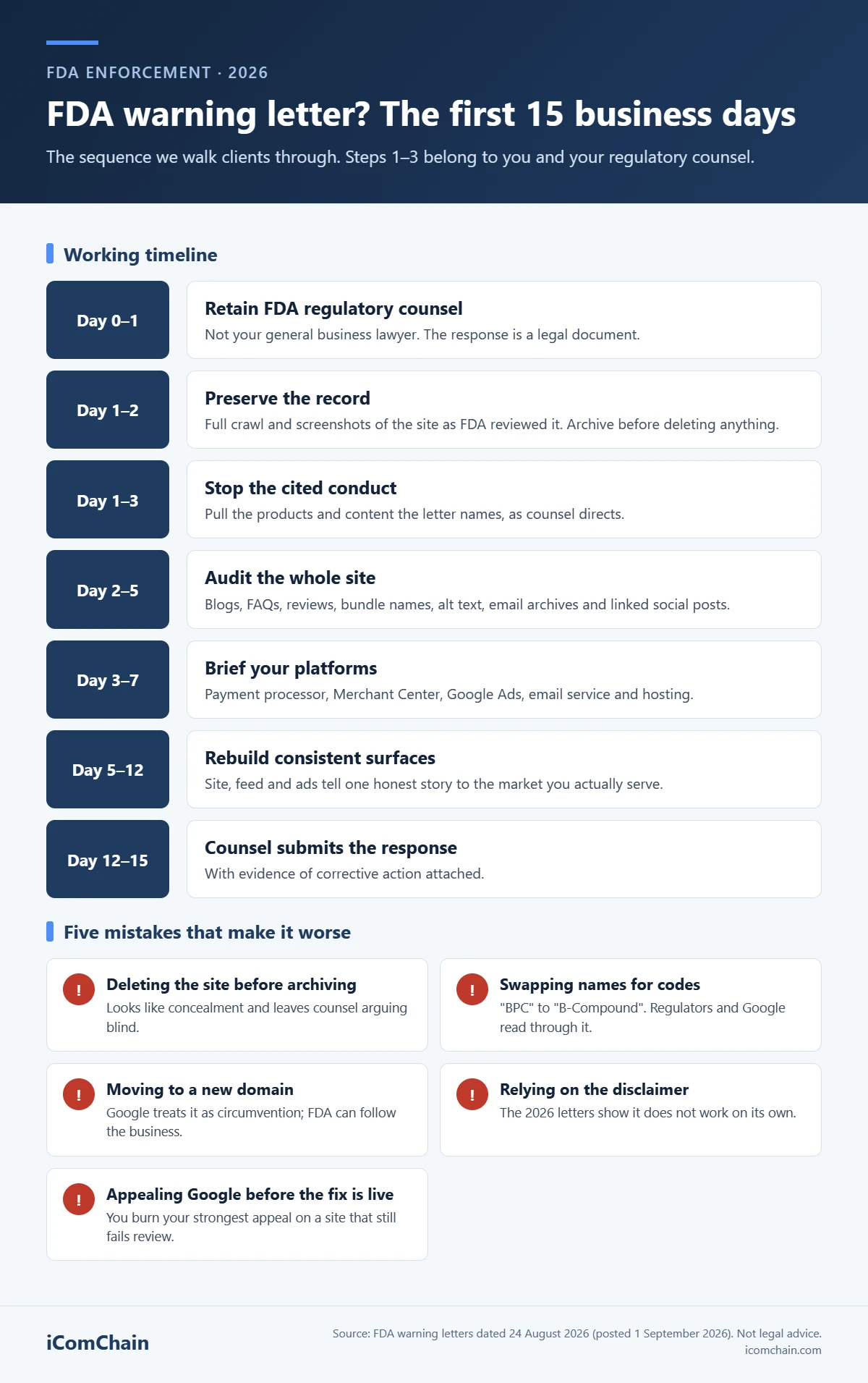
This is the sequence we walk clients through. Steps 1–3 belong to you and your lawyer; the rest is where an agency like ours helps.
- Day 0–1: Retain FDA regulatory counsel. Not your general business lawyer. The response letter is a legal document that may be read later in an enforcement action, and how you describe your business in it matters.
- Day 1–2: Preserve everything and freeze changes to the record. Take a full crawl and screenshots of the site as it stood when FDA reviewed it. Counsel will want to know exactly what was cited. Do not delete pages before you have archived them.
- Day 1–3: Stop the cited conduct. Pull the specific products and content the letter names, as counsel directs. FDA asks what you have done, not what you plan to do. “We removed X on [date]” is the kind of sentence a response needs.
- Day 2–5: Audit the whole site, not just the cited pages. FDA lists examples, not an exhaustive inventory. Blog posts, FAQs, product reviews, bundle names, image alt text, email archives and social posts linked from the site can all carry the same claims.
- Day 3–7: Brief your platforms before they brief you. Payment processor, Merchant Center, Google Ads, email service and hosting. See the next two sections.
- Day 5–12: Rebuild the commercial surfaces you still need. If counsel concludes some products can legitimately continue for genuine laboratory customers, the site, feed and ads have to tell one consistent story to that market only.
- Day 12–15: Response submitted by counsel, with evidence of corrective action attached.
If your customers are, in reality, individuals buying peptides to inject, no amount of copy editing makes that compliant, and we will not help you dress it up. The legitimate options are a genuine B2B laboratory-supply model, a properly licensed pharmacy or telehealth route for approved drugs, or exiting the affected products. Counsel should help you decide which applies.
What a warning letter means for Google Ads and Merchant Center
Google does not need an FDA letter to act. Its policies already prohibit unapproved pharmaceuticals and supplements and products “subject to any government or regulatory action or warning.” A public letter naming your products is exactly that.
Expect these outcomes
- Product disapprovals on named SKUs and their close equivalents, often within days of publication.
- Account-level suspension under the Healthcare and medicines policy or for misrepresentation if the site and feed keep showing the cited content. Google’s Merchant Center policy says egregious violations can be suspended without warning.
- Google Ads disapprovals on ads and keywords that reference the products, and potential account review.
What to do on the Google side
- Remove the cited products from your feed first, before Google finds them. A clean feed at the time of review is your best position.
- Pause ads and keywords that mention those products. Do not try to keep them live with misspellings or code names; that is the definition of circumventing systems and leads to permanent bans. See our guide to circumventing systems suspensions.
- Make the site, feed and Merchant Center business information match the corrected business. Inconsistency is what triggers misrepresentation.
- Do not open a new Merchant Center or Ads account to “start fresh.” Google links accounts by business, payment and domain signals.
- If you are suspended, appeal once, with evidence. Appeals that arrive before the site is actually fixed are the most common reason accounts end up with no appeal left. Read what to do if an appeal is denied and how repeated violations become entity-level bans.
Payments, email and the rest of your stack
In our experience the payment side moves fastest. Processors run automated monitoring on keywords and news mentions, and a named warning letter is a strong trigger. Industry write-ups describe termination followed by reserves or holds that can last 90–180 days. Plan cash flow on the assumption that funds in your current processor may be held.
- Payments: tell your processor’s risk team what you have removed, in writing, before they ask. Read our 72-hour processor shutdown plan.
- Email: archived campaigns are part of your marketing record. Platforms like Klaviyo enforce acceptable-use policies on content, not just products. See Klaviyo suspended your peptide store?
- Hosting and domain: some hosts and registrars act on regulatory complaints. Keep backups off-platform.
- Affiliates and social: claims made by affiliates or in reviews you display can be attributed to you. Audit them too.
Five mistakes that turn a letter into something worse
- Deleting the site before counsel has the archive. It looks like concealment and leaves your lawyer arguing blind.
- Swapping product names for codes (“BPC” to “B-Compound”). Regulators and Google both read through it.
- Moving to a new domain with the same catalogue. Google treats that as circumvention; FDA can follow the business.
- Relying on the disclaimer. The 2026 letters are direct evidence it does not work on its own.
- Appealing Google before the fix is live. You burn your strongest appeal on a site that still fails review.
16 questions answered
How long do I have to respond to an FDA warning letter?
FDA normally asks for a written response within 15 business (working) days of receipt, describing the specific steps taken to correct the violations and prevent recurrence. The NuScience letter in the 2026 sweep used that 15-business-day window. If you need more time to complete corrections, counsel can explain that in the response and give a timeline.
Is a warning letter the same as being shut down?
No. A warning letter is an informal, advisory notice. It is not a court order, conviction or recall. But it states FDA may pursue seizure or injunction without further notice if violations are not corrected, and it is published, so platforms and partners often act on it quickly.
Why didn’t my “research use only” disclaimer protect me?
Because FDA judges intended use from the totality of evidence. In the 2026 letters FDA pointed to therapeutic claims, dosing tools and reconstitution supplies on the same sites. A disclaimer cannot override a site that otherwise describes human use.
Which peptides were named in the 2026 letters?
Public reporting lists semaglutide, tirzepatide, retatrutide, survodutide, mazdutide, SS-31 (elamipretide), PT-141 (bremelanotide), tesamorelin and tesamorelin/ipamorelin blends, plus bacteriostatic water sold for reconstitution. The products varied by company.
Why was bacteriostatic water cited?
FDA said selling it alongside injectable peptides showed a combined intended use: reconstitution and injection by the buyer. In that context FDA treated the water as part of the drug offering.
Do I need a lawyer, or can my agency write the response?
You need FDA regulatory counsel. The response is a legal document and may be used later. An agency can help you execute corrections across your site, feed and ads, and document them for counsel, but should not draft legal positions.
Will Google suspend my Merchant Center account because of an FDA letter?
It can. Google’s Healthcare and medicines policy prohibits unapproved substances and products under regulatory action. A public letter naming your products is strong evidence. Removing those products from the feed and site before review is the best defence.
Can I keep running Google Ads while I respond?
Only for products and content that genuinely comply. Pause anything referencing the cited products. Running ads for them, or for disguised versions of them, risks permanent account loss for circumventing systems.
Should I open a new Merchant Center or Google Ads account?
No. Google links accounts through business identity, payment methods and domains. A new account for the same business after enforcement is treated as circumventing systems, which typically ends in a permanent ban across linked accounts.
Will my payment processor freeze my funds?
It may. High-risk payment providers report that mainstream processors often terminate peptide merchants and hold funds for 90–180 days to cover chargeback exposure. Brief your processor in writing on the corrective steps you have taken.
Do I have to take the whole website down?
Not necessarily, and you should not delete it before counsel has archived it. You must stop the cited conduct, which usually means removing specific products and content. Whether any part of the business can continue is a legal question for counsel.
What about my blog posts and old emails?
FDA treats website content as labeling, and blog posts, FAQs and linked material are part of that. Archived email campaigns linked from the site can also show intended use. Audit them as part of the response.
Does the July 2026 PCAC vote on BPC-157 and TB-500 change any of this?
No. The PCAC recommendations are advisory and only concern pharmacy compounding under section 503A after formal rulemaking. They do not make research-use-only sales to consumers lawful and did not cover the GLP-1 peptides named in the letters. See our PCAC explainer.
How do I get a warning letter closed?
FDA may issue a close-out letter once it has verified that the violations have been corrected, often after reviewing your response and, where relevant, later evidence. Counsel will advise on what documentation helps.
Can a compliant B2B laboratory supplier still advertise on Google?
Google’s healthcare policies are strict and many peptides are effectively unadvertisable regardless of audience. A genuine laboratory-supply business with no human-use positioning has the best chance, but eligibility depends on the specific products and Google’s current enforcement. We assess this case by case.
What does iComChain do in this situation?
We work alongside your counsel to execute and document the commercial side: auditing the site, feed and ads for cited content, cleaning Merchant Center and Google Ads, briefing platforms, and, where counsel confirms a compliant model, rebuilding the site and campaigns around it. We do not provide legal advice.
Letter on your desk, or worried one is coming?
Book a 15-minute call. We will tell you what Google, your processor and your email platform are likely to see, and the order to fix it in, alongside your counsel.
Sources
- Sheppard Mullin: FDA Balances Peptide Policy with Enforcement Against Unlawful Peptide Sellers
- Analysis of FDA’s September 2026 peptide warning-letter sweep
- Google Merchant Center Help: Healthcare and medicines policy
- Google Ads Policy Help: Healthcare and medicines
- FDA: About warning and close-out letters
This article is general information, not legal or regulatory advice. iComChain is a marketing and Merchant Center agency and is not a law firm. Research-use-only (RUO) products are intended for laboratory research only and not for human consumption, diagnostic or therapeutic use. iComChain does not manufacture, sell or distribute peptides. Facts reflect public sources available on 22 October 2026.